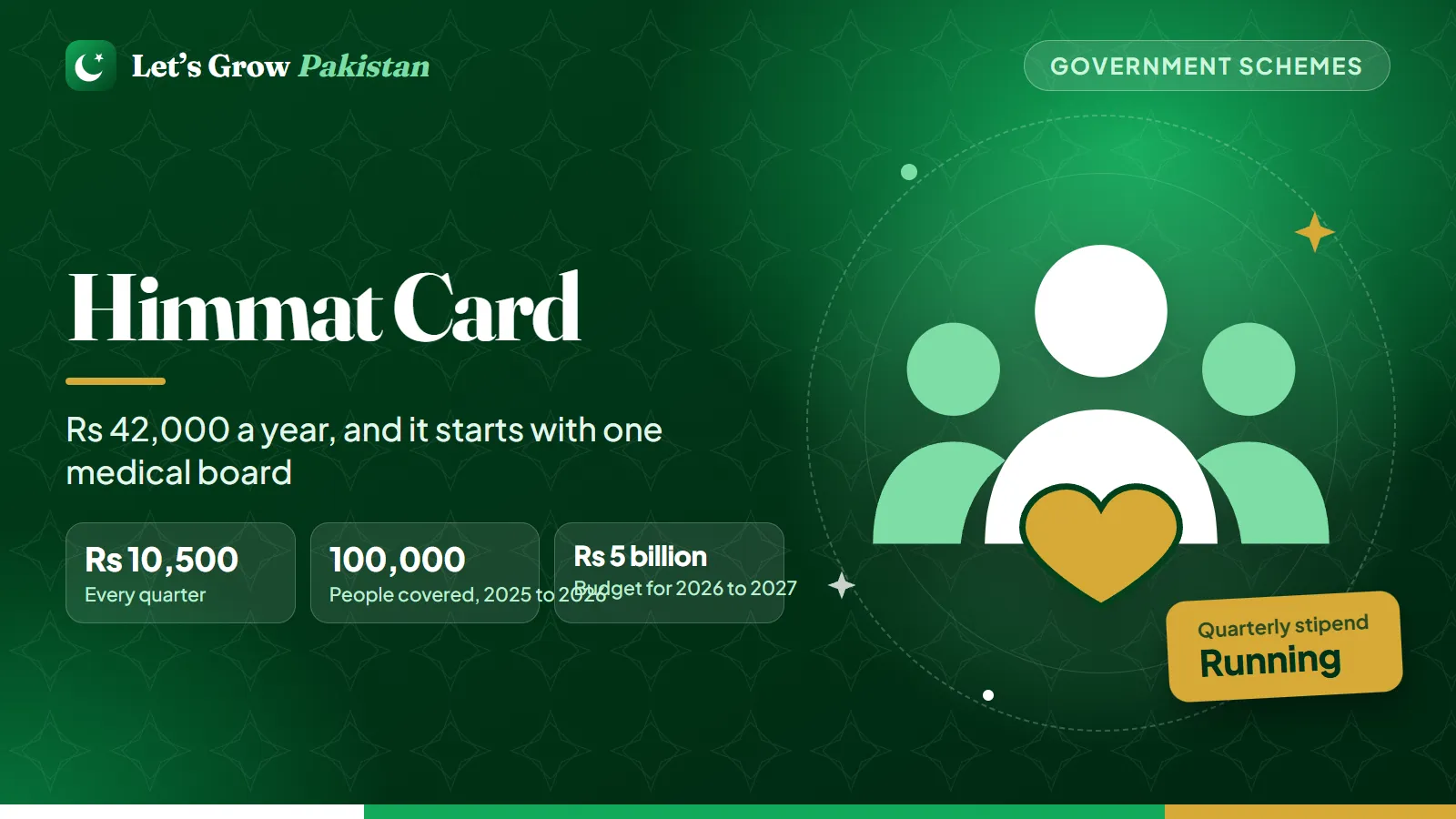
The Himmat Card pays Rs 10,500 every three months, on a Bank of Punjab card, to about 100,000 Punjab residents that an assessment board finds not fit to work. That one board finding decides the card, and most stuck applicants are stuck there, not at the bank.
- Rs 10,500
- Paid every quarter
- Rs 42,000
- A year, four payments
- 100,000
- People covered in 2025 to 2026
- Rs 5 billion
- Allocation for 2026 to 2027
The money, the card and the timing
The stipend is fixed at Rs 10,500 a quarter. Spread across the year, that is Rs 3,500 a month, though it never arrives monthly. It lands as one payment every three months.
| Item | What the rules say |
|---|---|
| Amount | Rs 10,500 per quarter |
| Yearly total | Rs 42,000 (our arithmetic, four quarters) |
| Paid through | A Bank of Punjab card, usable at ATMs for cash |
| Payment notice | An SMS with payment details goes to the holder |
| Fixed payment dates | Not published. Payments are described only as quarterly |
| Women’s quota | 30% of places |
| Programme approval | The DPMIS FAQ still says “until June 2025”, yet the June 2026 budget funds it for 2026 to 2027 |
Himmat card payment dates
The Himmat Card has no published payment date; it pays once a quarter. The government has never set a fixed calendar such as “the 15th of January”. The first payment was ordered for 15 September 2024, and cards were handed out from 3 October 2024. Since then the rule has simply been one payment per quarter. If a quarter passes without the SMS, that is the moment to call.
Himmat card payment check
The payment SMS is the Himmat Card payment check, because no separate payment portal exists. The DPMIS FAQ says an SMS with the payment details goes to the holder’s registered number each quarter. So the first check is the phone that was entered on DPMIS.
| Sign | What it tells you | Next step |
|---|---|---|
| Payment SMS received | The quarter’s Rs 10,500 has been sent | Draw it at any ATM with the Bank of Punjab card |
| No SMS, balance shows Rs 10,500 | Money arrived, the SMS did not | Update the mobile number on DPMIS |
| No SMS, no balance, quarter not over | Payment may still be on its way | Wait until the quarter ends |
| No SMS, no balance, quarter over | Something is stuck | Visit the district camp office or call 1312 |
A changed phone number is the quiet cause of many “missing” payments. The money sits in the account while the message goes to an old SIM. Updating the number on DPMIS restores the alert for the next quarter.
Five stops from certificate to first payment
The whole route runs through the Social Welfare Department. There is no SMS code for this card, and no form to post. Everything starts on the Disabled Persons Management Information System, known as DPMIS.
- 1
Register on DPMIS
Use a CNIC, Form B or birth certificate number, an active phone number, and pick the nearest medical board.
- 2
Face the assessment board
Go in person to the board's hospital. Doctors assess the disability and the ability to work.
- 3
Receive the disability certificate
Social Welfare issues it. For this card it must state not fit to work.
- 4
Complete the profile and wait
Fill in CNIC, address, phone, education and work history. Shortlisting is automatic, in batches.
- 5
Collect the card, get paid
Pass the biometric check, collect the Bank of Punjab card, and draw Rs 10,500 each quarter.
Himmat card registration online on DPMIS
Registration on DPMIS asks for very little. You choose a CNIC or Form B number, or a CRMS birth certificate number for a young child. Then you give a working phone number and choose a medical board by division, district and hospital. The portal also has video guides and an Android app.
There is no separate Himmat Card form. The same DPMIS profile that books the board date is the one the department later screens for the card. Registration is free, and no closing date has been announced.
3 documents for the Himmat card
The Himmat Card needs three documents, according to the DPMIS FAQ: a valid NADRA CNIC or Form B, the Social Welfare disability certificate, and current contact and address details. What you carry depends on who is applying.
| Case | Identity document | Also needed |
|---|---|---|
| Adult applying for self | Own valid CNIC registered in Punjab | Disability certificate marked not fit to work |
| Child with a disability | Child’s Form B, or CRMS birth certificate number at registration | Parent or guardian applies; the child’s certificate |
| CNIC has expired | Renewed CNIC from NADRA first | Expired cards are not accepted |
| Fingerprints fail at card collection | Same CNIC | Updated fingerprints through camp officers or a service provider |
The assessment board and the certificate
Disability board date and the hospital visit
Punjab’s Empowerment of Persons with Disabilities Act 2022 set up assessment boards in every district. The DPMIS portal lists 43 district boards (DAB) and 93 tehsil boards (TAB), each sitting in a government hospital. A district board is usually headed by the hospital’s medical superintendent, with a Social Welfare officer as secretary.
Every applicant appears in person. Doctors record the type and degree of disability, and whether the person can earn a living. That last finding is the one that decides the Himmat Card.
| Board finding | Disability certificate | Himmat Card |
|---|---|---|
| Disabled, not fit to work | Issued | Can qualify, if the other tests are met |
| Disabled, fit to work | Issued | Not eligible |
| Not assessed as disabled | Not issued | Not eligible |
A tehsil board can refer a case to the district hospital when a specialist is missing, but the certificate still comes from the board. Waits for a board date vary by district, so register early and keep the phone number active.
The special CNIC with the disability logo
NADRA issues a CNIC with a small disability logo to people who hold a disability certificate. It is useful for concessions and quotas. The Himmat Card rules, however, ask only for a valid CNIC or Form B plus the Social Welfare certificate. Applying does not require the logo card.
The six tests every applicant must pass
The Social Welfare Department’s Himmat Card page lists the conditions. Each one is checked against a database, not by an interviewer.
| Condition | What it means in practice | Checked through |
|---|---|---|
| Certified by Social Welfare Punjab | A valid disability certificate from an assessment board | DPMIS record |
| Not fit to work | The board found the person unable to earn a living | Certificate |
| Not employed | No job in a government or private office | Employment records |
| No other aid | Not recently paid by BISP, PSPA, Zakat, Bait ul Maal or similar | Other programme lists |
| PMT score of 45 or less | The poverty score from BISP’s household survey | BISP data |
| Punjab CNIC and full profile | CNIC registered in Punjab, with address, phone, education and work details updated | NADRA and DPMIS |
Himmat card age limit and children
There is no age limit in the official rules. A child with a disability can be covered, and the DPMIS FAQ says a parent or guardian applies on the child’s behalf. The child still needs a board certificate that says not fit to work.
BISP, Zakat and the “no other aid” test
The “no other aid” test screens out people already paid by BISP, PSPA or Zakat. If your family is on the BISP 8171 programme, ask the helpline before assuming the person with a disability also qualifies. The same applies to Zakat, Bait ul Maal and PSPA payments received recently.
PMT score 45 and the BISP survey
The PMT score is not something you apply for. It comes from the BISP survey of your household. If the family has never been surveyed, a score may simply be missing. Punjab’s own PSER registry is a separate survey, and the Himmat Card rules do not name it.
Checking status and fixing a stuck file
Selection is automated. The department says the first verified people with clean data were shortlisted first come, first served, so a complaint does not speed anything up. Fixing the data does. The answers below come from the official DPMIS FAQs.
Himmat card verification by CNIC
To check status, open the Himmat Card verification option on DPMIS and enter the CNIC, or the Form B for a child. You can also go to the district or tehsil Social Welfare and Bait ul Maal camp office. Data can be corrected even after a person has been shortlisted, either on the portal or at that office.
6 Himmat card rejection reasons and fixes
The six most common blocks are an incomplete profile, another aid list, fingerprints, an expired CNIC, bank details and a lost card.
| Problem | Likely cause | What to do |
|---|---|---|
| Not shortlisted | Incomplete profile or a later registration | Complete every DPMIS field, then wait for the next batch |
| Rejected on aid | Name found on BISP, PSPA or Zakat lists | Ask the 1312 helpline which list matched |
| Fingerprints do not match | Worn or changed prints | Update them through camp officers or a service provider, then retry |
| CNIC expired | Old card | Renew at NADRA before applying |
| Approved but no money | Wrong or missing bank details | Check the details, then contact Social Welfare |
| Card lost | Lost or stolen | Report to the Social Welfare Department and ask for a replacement |
Three of these causes cannot be fixed at a desk. A PMT score above 45, a board finding of fit to work, or a job all end the case under the rules. A person found fit to work can still look at the loans and devices listed further down.
Himmat card complaint and the 1312 helpline
The helpline is 1312. The FAQ says a complaint is not needed when a card simply has not arrived, because issuance runs automatically. Call when something is wrong instead: a payment missing after the quarter, a lost card, or a rejection you do not understand.
Social Welfare offices do not publish walk in addresses for general queries. The FAQ says locations go only to people updating data or attending a board. Everyone else uses 1312 or the district camp office.
How the programme grew
The Himmat Card grew from a 65,000 person plan to 100,000 people in two years. Three phases of cards and the June 2026 budget line took it there. By our arithmetic, the 2026 to 2027 budget covers about 119,000 people, short of the 200,000 target set in November 2025.
Phase I, II and III batches
The DPMIS FAQ describes the first two batches: 40,000 people, then 25,000. Anyone registered after 2 June, a date the FAQ gives without a year, was moved to the second batch. Phase III then added the cards announced in October 2025, though the batch size is disputed (see the note below).
Radio Pakistan, 27 August 2024; APP, 1 October 2025; Punjab budget speech, 17 June 2026.
- 27 August 2024Bank deal signed
Social Welfare and the Bank of Punjab agreed to issue 65,000 cards.
- 3 October 2024Cards handed out
The Chief Minister launched the card in Lahore.
- 15 October 2024Free metro travel
Holders could ride the Orange Line and Metro Bus free.
- 1 October 2025Phase III begins
The minister announced 35,000 more cards.
- 5 November 2025Target of 200,000
The minister set a 200,000 goal for the next year.
- 17 June 2026Budget for 2026 to 2027
Rs 5 billion was allocated after Rs 4.83 billion spent.

The Punjab government’s information office released this Urdu clip on 3 October 2024, the day the first cards were handed out. It introduces the card. The amount, rules and batch figures on this page are the current ones.
What Rs 5 billion can cover
The budget numbers tell their own story. In 2025 to 2026, Punjab spent Rs 4.83 billion on 100,000 people. At Rs 42,000 a year each, the stipend alone for that many people is Rs 4.2 billion. The rest likely covers cards and bank charges, though no breakdown was published.
For 2026 to 2027 the allocation is Rs 5 billion. Divided by Rs 42,000, that pays about 119,000 people for a full year, before any costs. The 200,000 target, announced at the Rawalpindi Phase III launch in November 2025, would need about Rs 8.4 billion in stipends alone. Unless funds are added during the year, a large jump in cardholders looks unlikely before mid 2027. This is our arithmetic, not an official forecast.
Cards for special education students
On 14 October 2025 the Social Welfare Department said it would issue 40,000 Himmat Cards to students with special needs, working with the Special Education Department. The decision came from a joint meeting chaired by minister Sohail Shaukat Butt. The department has not published how these students qualify, what they receive or when cards reach them. A complete DPMIS profile for the child is the one step parents control in the meantime.
Other support for persons with disabilities in Punjab
The Himmat Card is a cash stipend. Other help runs alongside it, and some of it is open to people who are fit to work and so cannot get the card.
| Support | What it gives | Latest figure | Who runs it |
|---|---|---|---|
| Free metro travel | Free rides on the Orange Line and Metro Bus in Lahore, Multan and Rawalpindi for cardholders | Announced October 2024 | Punjab government |
| Assistive devices | Wheelchairs, tricycles, hearing aids, artificial limbs and other aids | 18,803 people at Rs 1 billion in 2025 to 2026; Rs 3.7 billion for 40,000 people in 2026 to 2027 | Social Welfare Department |
| Interest free loans | Average loans of Rs 25,000 to Rs 100,000 to start a small business, run by Akhuwat with PSIC | Rs 270 million lent on a revolving basis since 2017, with full recovery reported | Punjab Social Protection Authority |
| Job quota | 3% of jobs reserved for persons with disabilities | Restated by the minister in October 2025 | Punjab government |
Interest free loans for those fit to work
The loan scheme is worth a closer look for anyone the board found fit to work. The PSPA income generation page says all persons with disabilities in Punjab are eligible. It does not explain how to apply, so call PSPA’s 1221 helpline first. Our income generation entry tracks what is confirmed.
4 more schemes for the family
Four other schemes often sit beside the Himmat Card in the same household:
- Health: Hospital bills are covered separately, so check whether the family is on the Sehat Card.
- Groceries: A registered worker in the household gets Rs 3,000 a month in groceries through the ration card.
- Imams: Bank of Punjab also pays mosque imams through the separate imam card.
- Weddings: A daughter of a disabled parent can qualify for a collective wedding under the Dhee Rani program.
Sources and the date of each check
| What | Where it comes from | Date |
|---|---|---|
| Amount, six conditions | Social Welfare Department Himmat Card page | Rechecked 19 November 2026 |
| Documents, batches, status, payments, lost card | DPMIS FAQs | Rechecked 19 November 2026 |
| 100,000 people, Rs 4.83 billion spent, Rs 5 billion allocated | Punjab budget speech, reported by APP | 17 June 2026 |
| Bank of Punjab deal for 65,000 cards | Radio Pakistan | 27 August 2024 |
| Launch and free metro travel | Punjab government notice | 3 October 2024 |
| Phase III and the 200,000 target | APP | 1 October and 5 November 2025 |
| 40,000 cards for special education students | Social Welfare Department news | 14 October 2025 |
Every other programme for persons with disabilities is listed in the schemes directory. This page changes when a new batch or a higher stipend is announced.
Frequently asked questions
How much does the Himmat Card pay?
The card pays Rs 10,500 every quarter, which adds up to Rs 42,000 a year. The money goes to a Bank of Punjab card, and an SMS tells the holder when a payment has been made.
Who is eligible for the Himmat Card?
A Punjab resident certified by Social Welfare as a person with a disability and assessed as not fit to work. The person must be jobless, have a PMT score of 45 or less, and get no aid from BISP, PSPA or Zakat.
Is there an age limit, and can a child get the Himmat Card?
There is no age limit in the official rules. A child with a disability can be covered through a parent or guardian, using the child's Form B and a disability certificate from the Social Welfare Department.
Which documents are needed for the Himmat Card?
A valid CNIC or Form B from NADRA, the disability certificate issued by the Social Welfare Department, and up to date contact and address details on DPMIS. A young child can be registered with a CRMS birth certificate number.
How do I check my Himmat Card status?
Use the Himmat Card verification option on the DPMIS portal with your CNIC, or visit your district Social Welfare office. Selection is automated, so a complaint is not needed if your card has not arrived yet.
What should I do if my Himmat Card payment is late?
Wait until the quarter has ended, since payments are made quarterly. If nothing arrives, check your bank details, then call the 1312 helpline or visit the district Social Welfare and Bait ul Maal camp office.
Last updated: