A Kafaalat mother who joins early in pregnancy and has a daughter can receive up to Rs 42,500 over the first 1,000 days. The money comes each quarter, with free food sachets, as long as the clinic visits are kept.
| Who is enrolled | Per quarter | Quarters paid | Most you can receive |
|---|---|---|---|
| Pregnant woman | Rs 3,500 | Up to 3, until delivery | Rs 10,500 |
| Boy under 2 | Rs 3,500 | Up to 8, until the 2nd birthday | Rs 28,000 |
| Girl under 2 | Rs 4,000 | Up to 8, until the 2nd birthday | Rs 32,000 |
| Pregnancy, then a girl | Up to 11 | Rs 42,500 | |
| Pregnancy, then a boy | Up to 11 | Rs 38,500 |
The quarterly rates come from BISP’s programme page, read on 14 November 2026. BISP gives Rs 42,500 as the most a beneficiary can receive. The quarter counts are our arithmetic, and they show how that figure is reached.
Nashonuma program amount per quarter
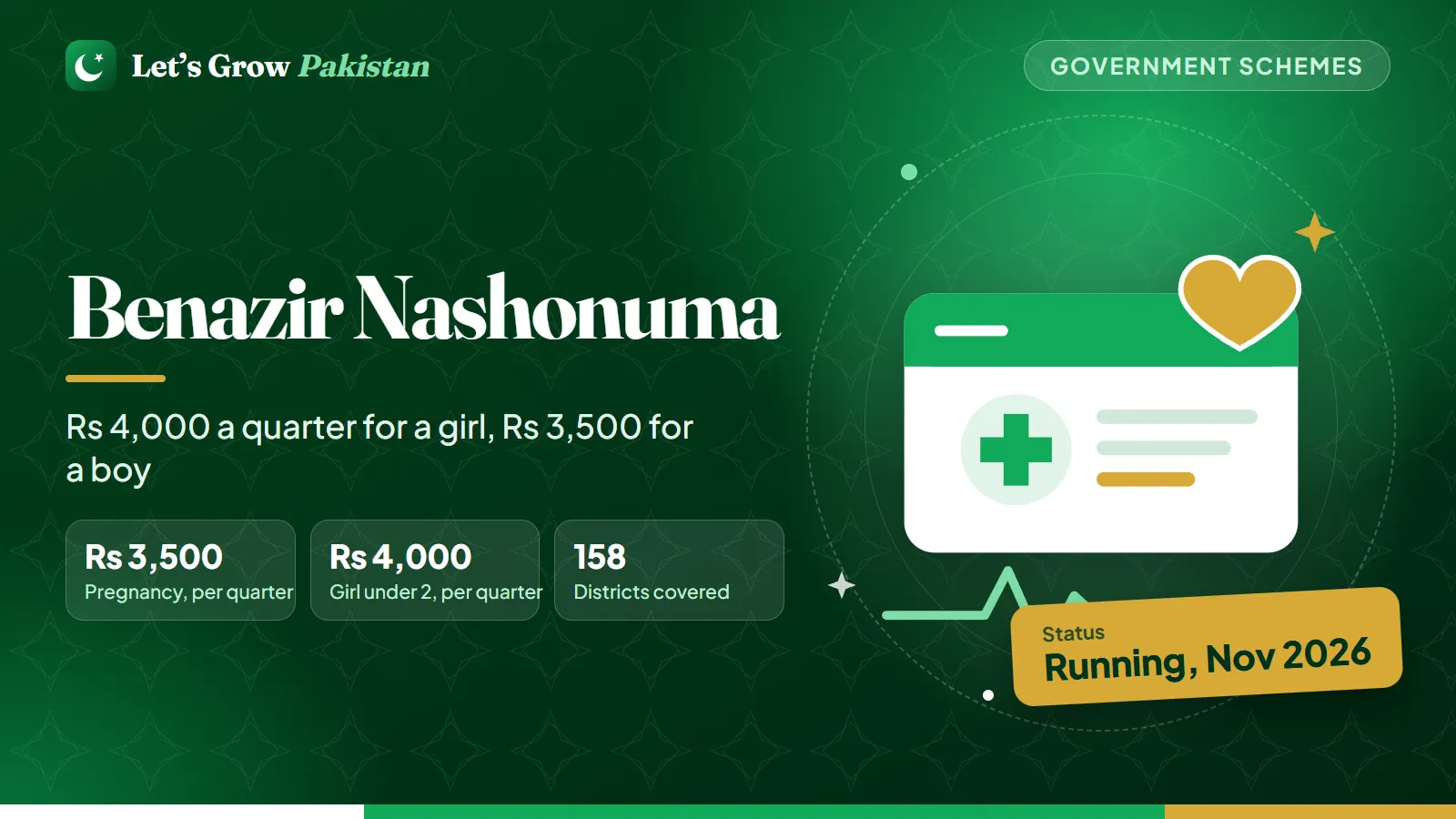
Rs 4,000 for a girl child
A daughter earns Rs 500 more a quarter than a son. BISP calls this part of the programme’s gender responsive design. Over eight quarters the gap adds up to Rs 4,000 per child.
Nashonuma amount calculator
Pick your stage below to see what is still ahead. Someone who enrols late in pregnancy, or with a child already a year old, has fewer quarters left.
Twins and a second child
BISP’s 2022 procedure says the conditions apply to twins and triplets too, so each child is enrolled and counted separately. A mother with a girl under 2 who becomes pregnant again would, on the published rules, hold two enrolments at once. Confirm this case at the centre, since BISP does not publish a worked example.
Older figures you may still see
Many websites still quote Rs 2,000, Rs 2,500 or Rs 3,000. Those are earlier amounts. BISP’s 2022 procedure linked a Rs 2,000 portion (Rs 2,500 for a girl) to food and clinic compliance. The Economic Survey 2024 to 2025 also printed lower figures than BISP’s current page.
Who can join Benazir Nashonuma
Kafaalat comes first
Nashonuma is not a separate registration route into BISP. The mother must already be an active Kafaalat beneficiary, which means her household passed the NSER poverty survey. If you are not in Kafaalat, start with the NSER survey at your BISP tehsil office.
Age and stage rules
| Person | Rule on BISP’s page |
|---|---|
| Pregnant woman | Any stage of pregnancy, aged 18 to 59, already in Kafaalat |
| Nursing mother | Breastfeeding, aged 18 to 59, already in Kafaalat |
| Child | Under 2 years old, child of a Kafaalat beneficiary |
| Home | Inside a district where Nashonuma has been rolled out |
The programme targets the first 1,000 days, from conception to the second birthday. BISP’s 2022 procedure listed children aged 6 to 23 months. The current page covers every child under 2.
Districts where Nashonuma runs
BISP says the programme now reaches 158 districts. It began as a pilot in 9 districts in August 2020 and grew to 15 before the national rollout. That covers most of the country, but ask your tehsil office whether your area has a centre.
BISP programme page and APP report, checked 14 November 2026
Nashonuma 8171 check by CNIC
What the 8171 reply tells you
Send your 13 digit CNIC to 8171, or enter it on the 8171 portal. The reply says whether your household is eligible for Kafaalat. Our 8171 check guide explains each reply message and the Rs 14,500 Kafaalat amount.
What it does not tell you
We found no BISP statement that 8171 shows Nashonuma enrolment or payment. At the centre, staff search your CNIC in BISP’s Nashonuma Android app, according to the 2022 procedure. That app, not 8171, confirms your Nashonuma status.
Nashonuma registration at a facilitation centre
There is no online form. Every enrolment happens in person at a Nashonuma facilitation centre, which BISP runs with the provincial health departments.
Papers to take
- The mother’s original CNIC
- The child’s NADRA Form B or Family Registration Certificate (FRC)
- The child’s EPI vaccination card
- For a pregnancy, any test or scan report you have; the centre’s doctor confirms it
- 1
Check Kafaalat
Send your CNIC to 8171. Only Kafaalat households can enrol.
- 2
Go to the centre
Take the CNIC, Form B or FRC and the EPI card to the nearest facilitation centre.
- 3
Record check
Staff search your CNIC in the Nashonuma app against BISP's register.
- 4
Doctor's check
A doctor confirms the pregnancy, or the child's age and vaccines.
- 5
Food and visits
Collect the food sachets and keep every clinic and growth visit.
Nashonuma centre near me
BISP counts 558 facilitation centres on its programme page, including mobile units. The World Food Programme put the number at 578 in July 2026. Ask your BISP tehsil office or call 0800-26477 for the nearest one, since no official online map was found.
When the doctor cannot confirm
BISP’s 2022 procedure says a woman or child who cannot be verified is sent back to the registration counter. There the record is marked not eligible for the programme. Ask the counter staff what proof they need before you try again.

BISP published this seven minute documentary on its official channel in November 2022, and links it from its Nashonuma page. It introduces the programme as BISP ran it then. The payment amounts have risen since, so use the table at the top for today’s figures.
Conditions that keep the payment coming
Nashonuma is a conditional transfer. Each quarter’s money is released only after the centre records that the conditions were met.
| Condition | Who | How often |
|---|---|---|
| Antenatal and postnatal checkups, with awareness sessions | Mother | Regular visits through pregnancy and after birth |
| Specialised nutritious food | Mother and child | One sachet a day, at least 90% eaten |
| Routine immunisation | Child, and the mother in pregnancy | On the national EPI schedule |
| Growth monitoring | Child under 2 | Every quarter |
Maamta and Wawamum sachets
BISP’s procedure names the two foods. A pregnant or nursing woman gets Maamta, one 75 gram sachet a day. A child aged 6 to 23 months gets Wawamum, one 50 gram sachet a day. Sachets that are not eaten count against the 90% rule.
Quarterly growth checks
Children are weighed and measured at the centre every quarter. The check is timed with BISP’s quarterly payment cycle, so a missed visit can delay that quarter’s money.
How the Nashonuma money is paid
BISP’s platform links enrolment, compliance and payment with NADRA and its partner banks. The money is released only after the quarter’s compliance is verified.
Digital wallet and the Rs 280 fee
Since July 2026, BISP pays Kafaalat through a digital wallet on a free Benazir SIM. Cash withdrawal from that wallet costs Rs 280, and any larger cut is not allowed. The 8171 guide covers the withdrawal steps.
Taleemi Wazaif alongside Nashonuma
Nashonuma ends at the second birthday. Once a child starts school, the same family can claim Taleemi Wazaif stipends for attendance. Both come from the Kafaalat record, so no new survey is needed.
Nashonuma complaints and helpline
Official channels only
Call the toll free BISP helpline 0800-26477 for a missing payment, a refused enrolment or a centre problem. You can also visit your BISP tehsil office, or lodge a complaint on the Pakistan Citizen Portal.
Fake messages
BISP sends messages only from 8171. Nashonuma enrolment is free, and no one at a centre may charge for registration or sachets. Report anyone asking for money to 0800-26477.
Results the programme has shown
- 4.6 million
- Women and children reached since 2020
- 22%
- Less stunting at 6 months
- 169
- Nutrition stabilization centres
- 97%+
- Cure rate for severely malnourished children
The Aga Khan University evaluation
On 29 June 2026 the World Food Programme published results from an evaluation by Aga Khan University, funded by the Gates Foundation. Enrolled children were 22% less likely to be stunted at 6 months and 18% less likely at 12 months. Child anaemia fell by 12% and low birth weight by 6%. Full immunisation rose by 17%.
Where it still falls short
The same evaluation found fewer than 25% of women ate a diverse enough diet. The sachets help, but the cash alone does not fix what the rest of the family eats.
Reach by source
| Figure | Count | Source and date |
|---|---|---|
| Beneficiaries since 2020 | 4.6 million (2.1 million women, 2.5 million children) | BISP programme page, read 14 Nov 2026 |
| People reached since 2020 | 4.7 million | WFP, 10 July 2026 |
| Facilitation centres | 558 | BISP programme page |
| Facilitation centres | 578 | WFP, 10 July 2026 |
| Nutrition stabilization centres | 169 | BISP page and WFP, 29 June 2026 |
| Nutrition stabilization centres | 224 | WFP, 10 July 2026 |
| Severely malnourished children treated | 53,000 | BISP programme page |
The counts differ because each source was updated at a different time. Stabilization centres treat children with severe acute malnutrition, while facilitation centres handle enrolment and food.
Latest Nashonuma news
Three year extension in July 2026
On 9 July 2026 in Islamabad, BISP, WFP, UNICEF and WHO extended their partnership for three more years. The aim is to reach another 3.3 million women and children, taking the total to about 8 million. The quarterly amounts did not change.
November 2026
On 12 November 2026 BISP officials discussed Nashonuma with the World Bank, alongside the NSER and the Hunarmand skills programme. No new amount, district or deadline came out of the meeting. The rates on BISP’s Nashonuma page were unchanged on 14 November 2026.
Frequently asked questions
How much is the Nashonuma program payment in 2026?
BISP pays Rs 3,500 a quarter to a pregnant woman, Rs 3,500 a quarter for a boy under 2 and Rs 4,000 for a girl under 2. Over the first 1,000 days one beneficiary can receive up to Rs 42,500.
How do I register for Benazir Nashonuma?
Registration is in person, not online. A Kafaalat mother visits the nearest Nashonuma facilitation centre with her CNIC, the child's Form B or FRC and the EPI card. Staff check her record and a doctor confirms the pregnancy or the child.
Can I check Nashonuma through 8171?
The 8171 check shows whether your household is eligible for Kafaalat, which is the first condition for Nashonuma. We found no BISP statement that the 8171 reply shows Nashonuma enrolment, so ask at the centre for that.
Who is eligible for the Nashonuma program?
Pregnant or breastfeeding women aged 18 to 59 who already receive Kafaalat, and the children under 2 of Kafaalat mothers. The family must live in a district where the programme runs, which BISP put at 158 districts.
What food is given under Nashonuma?
BISP's procedure names two daily sachets. Pregnant and nursing women get Maamta, 75 grams a day. Children aged 6 to 23 months get Wawamum, 50 grams a day. At least 90% must be eaten to release the payment.
What is the Nashonuma helpline number?
The BISP helpline 0800-26477 is toll free and handles Nashonuma questions and complaints. You can also visit the BISP tehsil office. Only messages from 8171 are genuine BISP messages, so ignore calls asking for fees.
Last updated: