No government has approved 12 provinces. What exists is a 12 province formula under discussion in Islamabad, and a district list built on it that spread online in November 2026.
Proposed 12 provinces list with 2023 census population
This is the district list that circulated online, with every population recomputed from the official census. We could not trace who drew it up.
| Proposed province | Now part of | Proposed capital | Districts | Population 2023 | Share of Pakistan |
|---|---|---|---|---|---|
| Northern Punjab | Punjab | Rawalpindi | 10 | 26,046,632 | 10.8% |
| Northeastern Punjab | Punjab | Lahore | 8 | 36,502,717 | 15.1% |
| Central Punjab | Punjab | Faisalabad | 7 | 24,761,997 | 10.3% |
| Southern Punjab | Punjab | Multan | 11 | 40,377,576 | 16.7% |
| Coastal Sindh | Sindh | Karachi | 10 | 24,252,445 | 10.0% |
| Central Sindh | Sindh | Hyderabad | 12 | 18,339,955 | 7.6% |
| Northern Sindh | Sindh | Sukkur | 8 | 13,103,747 | 5.4% |
| Northern KP | Khyber Pakhtunkhwa | Peshawar | 24 | 30,822,804 | 12.8% |
| Southern KP | Khyber Pakhtunkhwa | Dera Ismail Khan | 11 | 10,033,293 | 4.2% |
| Western Balochistan | Balochistan | Quetta | 17 | 9,896,054 | 4.1% |
| Eastern Balochistan | Balochistan | Dera Murad Jamali | 17 | 4,998,348 | 2.1% |
| Federal Capital | Islamabad Capital Territory | Islamabad | 1 | 2,363,863 | 1.0% |
| Total | 136 | 241,499,431 | 100% |
Pakistan Bureau of Statistics, Census 2023, district Table 1
How we checked the circulated figures
We added up every district from the 2023 census tables of the Pakistan Bureau of Statistics. All 12 totals match the circulated list exactly. Every one of the 135 census districts in the four provinces appears once, plus Islamabad.
The arithmetic holds, but the shape does not match the reporting. The News described Punjab split into four, Khyber Pakhtunkhwa and Balochistan into three each, and Sindh into two. The online list splits Sindh into three, KP and Balochistan into two each, and counts Islamabad as the twelfth unit.
ARY News gave yet another version on 14 November, with two units each for Sindh, KP and Balochistan. So treat the list as one person’s model, not the government’s map.
Districts the list does not name
The list follows the 2023 census, so it misses districts that exist on paper but were counted inside older ones. If you live in one of these, the tool above shows the parent district.
| District | What happened | Counted inside, 2023 census | Where the list would put it |
|---|---|---|---|
| Murree | Notified by Punjab’s Board of Revenue, late 2022 | Rawalpindi | Northern Punjab |
| Talagang | Notified by Punjab’s Board of Revenue, late 2022 | Chakwal | Northern Punjab |
| Wazirabad | Notified by Punjab’s Board of Revenue, late 2022 | Gujranwala | Northeastern Punjab |
| Kot Addu | Notified by Punjab’s Board of Revenue, late 2022 | Muzaffargarh | Southern Punjab |
| Taunsa | Reports conflict on whether it was notified | Dera Ghazi Khan | Southern Punjab |
| Hub | Notified by Balochistan, September 2022 | Lasbela | Western Balochistan |
| Usta Muhammad | Approved by Balochistan’s cabinet, June 2022 | Jaffarabad | Eastern Balochistan |
| Karezat | Approved by Balochistan’s cabinet, June 2022 | Pishin | Western Balochistan |
The census counted Murree tehsil at 252,526 people, Wazirabad tehsil at 993,412 and Kot Addu tehsil at 1,072,180. A new district’s borders can differ from the old tehsil, so these are a guide only.
Who proposed 12 provinces and when
The number 12 has come from several directions since July 2026. None of them is a government decision.
| Stage | Has it happened? | Detail |
|---|---|---|
| Official decision or notification | No | Nothing published by the federal cabinet or any assembly |
| Bill in the National Assembly or Senate | No | No 28th Amendment text tabled so far |
| Federal committee recommendation | No | The PM’s coordinator said in September that no such committee existed |
| Ministers and parties in favour | Yes | Khawaja Asif, Ahsan Iqbal, Mohsin Naqvi, MQM-P and IPP |
| Unofficial lists and maps | Yes | Viral maps since July, and this district list in November |
The formula reported on 8 November
Ansar Abbasi of The News reported a proposal “to redraw Pakistan’s administrative map into 12 provinces”. It cited unnamed sources and named no official. A nationwide referendum would come first, with preparatory steps possibly in the first quarter of 2027.
The same report said the constitutional amendment “could be taken up in the first half of 2027”. It added that the proposal “remains at the consideration stage.”
Ministers who have backed more provinces
Defence Minister Khawaja Asif told Geo News that Pakistan could have up to 12 provinces. He said they “should not be created on the basis of language, ethnicity or political interests.”
Planning Minister Ahsan Iqbal told The News on 4 September that Pakistan needs 12 to 15 new provinces. He asked the Prime Minister to set up a committee to start a national debate.
Interior Minister Mohsin Naqvi started this round at the Pakistan Economic Summit in late July, saying the governance system had failed. On 12 November he suggested a public referendum could settle the question.
Federal Minister Abdul Aleem Khan of the IPP proposed splitting each province into three. Minister of State for Law Aqeel Malik suggested four or five units for Punjab and three or four for Sindh.
What the government has not said
Rana Ihsaan Afzal, the Prime Minister’s coordinator, told The News in September that no federal committee had been formed. On 15 November Daily Pakistan reported that neither the Presidency nor the PM Office confirmed any talks on new provinces.
The Presidency said Naqvi’s meeting with President Zardari was about national security and regional developments. ARY News, citing unnamed sources, reported on 14 November that a referendum could come before the Senate elections expected in March 2027.
Other numbers in circulation
The Economic Policy and Business Development think tank set out three models in August 2025. They were 12 provinces of about 20 million people each, 15 to 20 provinces, or 38 federal divisions.
A map shared on social media in late July 2026 showed 18 units. Aaj News reported that no government official had endorsed it. A government source told Dawn in August of a smaller option, with Karachi and Gwadar under federal control.
Punjab split into four proposed provinces
Punjab had 127,688,922 people in the 2023 census, more than half of Pakistan. The list splits its 36 districts into four units of 24.8 to 40.4 million.
Northern Punjab with Rawalpindi as capital
Northern Punjab joins the Rawalpindi, Gujrat and Sargodha regions in 10 districts. Its people number 26,046,632 over 54,479 square kilometres. Rawalpindi district alone has 6,118,911.
The unit stretches from Attock on the Indus to Bhakkar and Mianwali in the Thal desert. That choice is notable. The 2013 Senate bill for a Bahawalpur Janoobi Punjab province placed Mianwali and Bhakkar in the south.
Northeastern Punjab with Lahore as capital
Eight districts from Lahore to Sialkot and Narowal make up 36,502,717 people. Lahore district holds 13,004,135 of them, the largest district population in the country.
This would be the most crowded of the 11 provincial units. It packs about 1,582 people into each square kilometre, against 478 in Northern Punjab.
Central Punjab with Faisalabad as capital
Faisalabad, Chiniot, Jhang, Toba Tek Singh, Okara, Pakpattan and Sahiwal form a unit of 24,761,997 people. Faisalabad district counts 9,075,819. The ruins of Harappa near Sahiwal would sit in this unit.
Southern Punjab with Multan as capital
Southern Punjab would be the largest unit on the list, with 40,377,576 people in 11 districts. It covers the Multan, Bahawalpur and Dera Ghazi Khan regions on 99,577 square kilometres.
The list folds the old Bahawalpur state into this unit. Bahawalpur, Bahawalnagar and Rahim Yar Khan alone count 13,400,009 people. The Punjab Assembly asked on 9 May 2012 for Bahawalpur to be restored as a province, separately from a South Punjab province.
A South Punjab secretariat already exists as an administrative step. Punjab appointed its first additional chief secretary on 30 June 2020, with offices split between Multan and Bahawalpur.
Sindh split into three in the circulated list
Sindh had 55,696,147 people in 2023 across 30 districts. The list divides them three ways, although the formula The News reported has only two Sindh units.
Coastal Sindh with Karachi as capital
Karachi’s seven districts hold 20,382,881 people. With Badin, Sujawal and Thatta the unit reaches 24,252,445. MQM-P has long called for a separate province in Sindh, which is why this unit draws the strongest reaction.
Central Sindh with Hyderabad as capital
Twelve districts from Dadu and Jamshoro down to Tharparkar and Umerkot form a unit of 18,339,955 people. Hyderabad district counts 2,432,540, and Sanghar 2,308,465.
Northern Sindh with Sukkur as capital
Eight districts on the upper Indus make up 13,103,747 people. Khairpur is the largest at 2,597,535. Mohenjo Daro in Larkana would fall in this unit.
Khyber Pakhtunkhwa split into two in the circulated list
KP had 40,856,097 people in 35 districts in 2023, including the merged tribal districts. The list cuts it into a northern and a southern unit.
Northern KP with Peshawar as capital
Northern KP is the list’s largest unit by district count, with 24 districts and 30,822,804 people. It runs from Peshawar and Mardan to Chitral, Swat and the Hazara region.
The Hazara region’s eight districts alone count 6,188,736 people. The KP Assembly backed a separate Hazara province on 21 March 2014, again on 4 January 2022 and again in December 2025. This list does not give Hazara its own unit.
Southern KP with Dera Ismail Khan as capital
Eleven districts from Kohat and Kurram to Bannu, both Waziristans and Dera Ismail Khan make up 10,033,293 people. Dera Ismail Khan district counts 1,829,811.
Balochistan split into two in the circulated list
Balochistan is the largest province by area and the smallest by population, with 14,894,402 people in 34 districts. The list draws a west to east line.
Western Balochistan with Quetta as capital
Seventeen districts, from Quetta and Pishin to Gwadar, Kech and Chagai, hold 9,896,054 people. They spread over 256,989 square kilometres, or about 39 people per square kilometre.
Eastern Balochistan with Dera Murad Jamali as capital
Seventeen districts from the Nasirabad plains to Zhob make up 4,998,348 people. That makes it the smallest of the 11 provincial units. Dera Murad Jamali is a town in Nasirabad district, which counts 563,315 people.
Islamabad, Gilgit-Baltistan and Azad Kashmir
Why Islamabad is counted as the twelfth unit
Article 1 of the Constitution names four provinces and the Islamabad Capital Territory. The list labels Islamabad “Federal Capital” and counts it as its twelfth unit, with 2,363,863 people. So the list really proposes 11 provinces plus the capital.
Why Gilgit-Baltistan and AJK are not on the list
Gilgit-Baltistan and Azad Jammu and Kashmir are not provinces under Article 1. They run their own governments and assemblies. The PBS district tables used here also leave them out, which is why the total is 241,499,431.
Constitutional route for a new province
What Article 239(4) says
The Constitution’s text sets the bar in Article 239(4). It covers any amendment bill “which would have the effect of altering the limits of a Province”. Such a bill cannot go to the President unless that province’s assembly passes it. The vote must be “not less than two-thirds of its total membership.”
There is no separate procedure for creating a province. A new one needs an amendment to Article 1 and to the articles that set seats, so Article 239 applies in full.
Votes a split would need
| House | Total seats | Two thirds needed |
|---|---|---|
| National Assembly | 336 | 224 |
| Senate | 96 | 64 |
| Punjab Assembly | 371 | 248 |
| Sindh Assembly | 168 | 112 |
| Khyber Pakhtunkhwa Assembly | 145 | 97 |
| Balochistan Assembly | 65 | 44 |
Each provincial vote applies only if that province’s limits change. Under the circulated list, all four would need to agree.
The referendum route under Article 48(6)
Article 48(6) lets the Prime Minister refer a matter of national importance to a joint sitting of Parliament. If the joint sitting approves, it can go to a referendum.
Rana Sanaullah said in September that any referendum would need Parliament’s approval. Daily Pakistan reported on 15 November, citing sources, that President Zardari and PM Shehbaz agreed neither Parliament nor the provincial assemblies could be bypassed.
What a new province has to set up
Each new province would need its own assembly, governor, chief minister, high court and civil service. Dawn has noted the cost of these offices. No government estimate of that cost has been published.
Arguments for and against new provinces
The case made by supporters
Khawaja Asif argues decentralisation would let “resources and administrative decisions” reach communities more directly. PTI chairman Barrister Gohar Khan called new provinces a necessity in early August, but only with broad consensus and two thirds votes.
MQM-P’s Mustafa Kamal said in Karachi on 15 November that December would be a crucial month. The Supreme Court Bar Association backed the idea in August, Dawn reported.
The case made by opponents
PPP chairman Bilawal Bhutto Zardari said in Karachi on 27 October that the discussion on creating new administrative units “must stop”. He added that the federal government had not approached the PPP about a 28th amendment.
The Sindh Assembly passed a resolution against any division of Sindh in early September 2026, amid an MQM-P boycott. The Pakistan Bar Council said any change must go through Parliament with national consensus. Commentator Suhail Waraich called it “simply not doable”.
Money and Senate seats
Under the 7th NFC Award, provinces share federal revenue as Punjab 51.74%, Sindh 24.55%, Khyber Pakhtunkhwa 14.62% and Balochistan 9.09%. Population carries 82% of the weight. Any new province would need a new NFC formula.
Article 59 gives every province the same 23 Senate seats. Ahsan Iqbal pointed out that splitting Punjab would raise its share of the Senate, so any plan needs a fair formula.
What changes for you today
Your domicile, CNIC and quotas stay as they are
Nothing changes until an amendment is passed and notified. Your domicile, CNIC address, provincial job quotas and university seats still follow your current province and district.
What to watch next
Watch for three things. A bill or draft amendment published on the National Assembly or Senate website. A joint sitting called under Article 48(6). And a resolution in any provincial assembly.
Timeline of the new provinces debate
- 1955 to 1970One Unit
West Pakistan's provinces were merged into a single unit, then restored in 1970.
- 9 May 2012Punjab Assembly resolutions
Unanimous resolutions for a South Punjab province and for restoring Bahawalpur province.
- 6 March 2013Senate passes 24th Amendment bill
70 votes for a Bahawalpur Janoobi Punjab province. It never became law.
- 21 March 2014KP Assembly backs Hazara province
Reaffirmed on 4 January 2022 and again in December 2025.
- 30 June 2020South Punjab secretariat
Punjab appoints the first additional chief secretary for South Punjab.
- Late July 2026Naqvi says the system has failed
The interior minister calls for consensus on smaller units at the Pakistan Economic Summit.
- 4 September 2026Ahsan Iqbal proposes 12 to 15
The planning minister asks the PM for a committee.
- Early September 2026Sindh Assembly resolution
The assembly rejects any division of Sindh.
- 8 November 202612 province formula reported
The News reports the plan and a referendum before any amendment.
- 12 November 2026Referendum suggested
Mohsin Naqvi says a public vote could settle the question.
- First half of 2027Possible amendment
The timing reported by The News. Not confirmed by the government.
Frequently asked questions
Is Pakistan going to have 12 provinces?
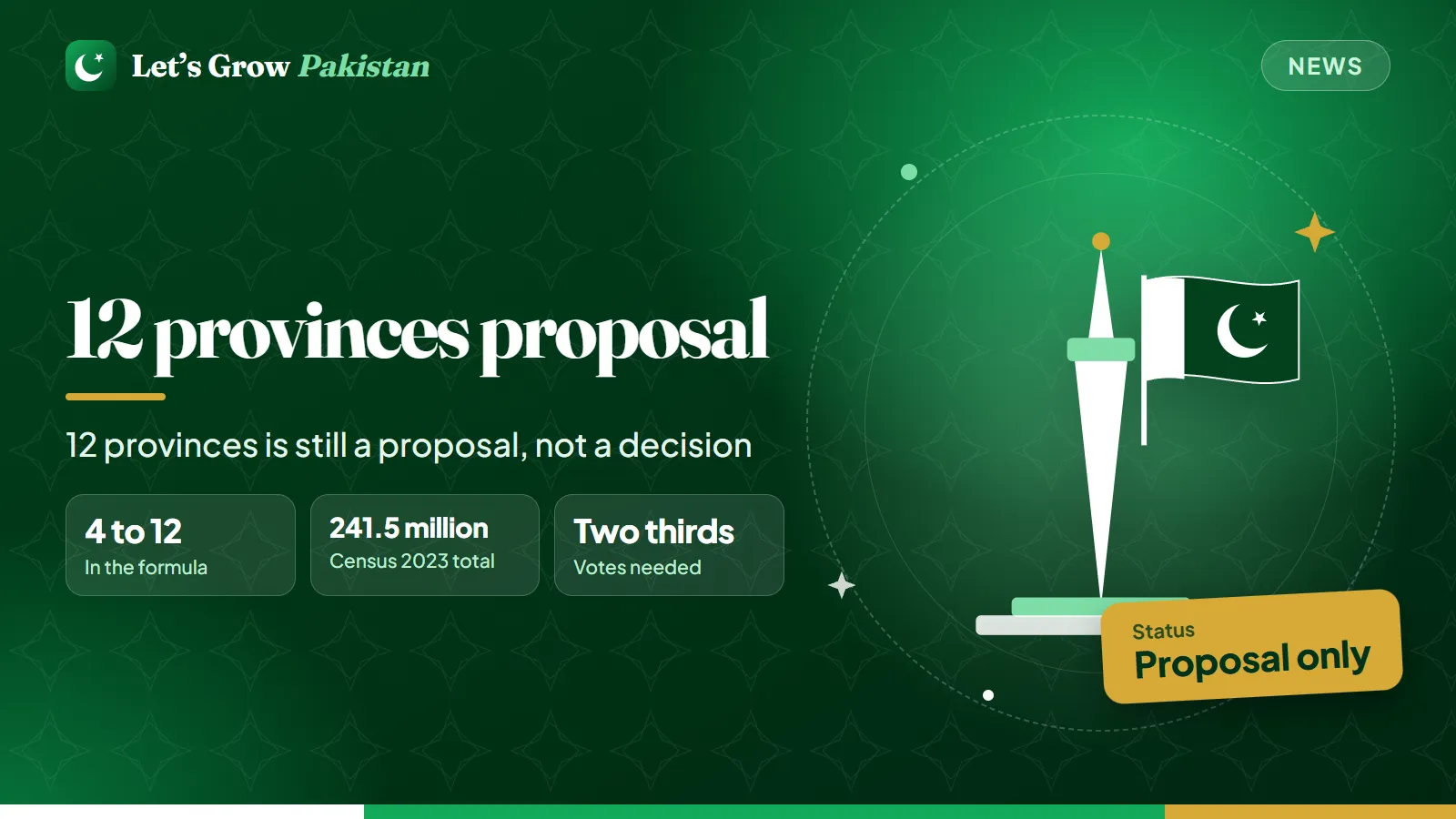
Not as of 17 November 2026. A 12 province formula is under discussion and ministers have spoken in favour, but no bill, draft amendment or official boundary map has been published. Any split needs two thirds votes in Parliament and in the affected provincial assembly.
What are the 12 proposed provinces of Pakistan?
The list shared online names Northern, Northeastern, Central and Southern Punjab, Coastal, Central and Northern Sindh, Northern and Southern KP, Western and Eastern Balochistan, and the Federal Capital. Its author is not confirmed, and it differs from the formula reported by The News.
Can a new province be made without the provincial assembly's approval?
Not under the Constitution as it stands. Article 239(4) says an amendment that alters a province's limits cannot go to the President unless that province's assembly passes it by two thirds of its total membership.
Will there be a referendum on new provinces in Pakistan?
Ministers including Mohsin Naqvi have suggested one, and press reports say groundwork has started. Article 48(6) allows a referendum only after a joint sitting of Parliament approves it, and none had been called by 17 November 2026.
What is the 28th Amendment about new provinces?
It is the name used in reports for a possible next constitutional amendment that could deal with new provinces. The News reported it might come in the first half of 2027. No text of such a bill has been made public so far.
Which proposed province would have the most people?
Southern Punjab, with 40,377,576 people in the 2023 census across 11 districts from Multan, Bahawalpur and Dera Ghazi Khan divisions. Northeastern Punjab follows with 36,502,717, most of them in Lahore district alone.
Last updated: