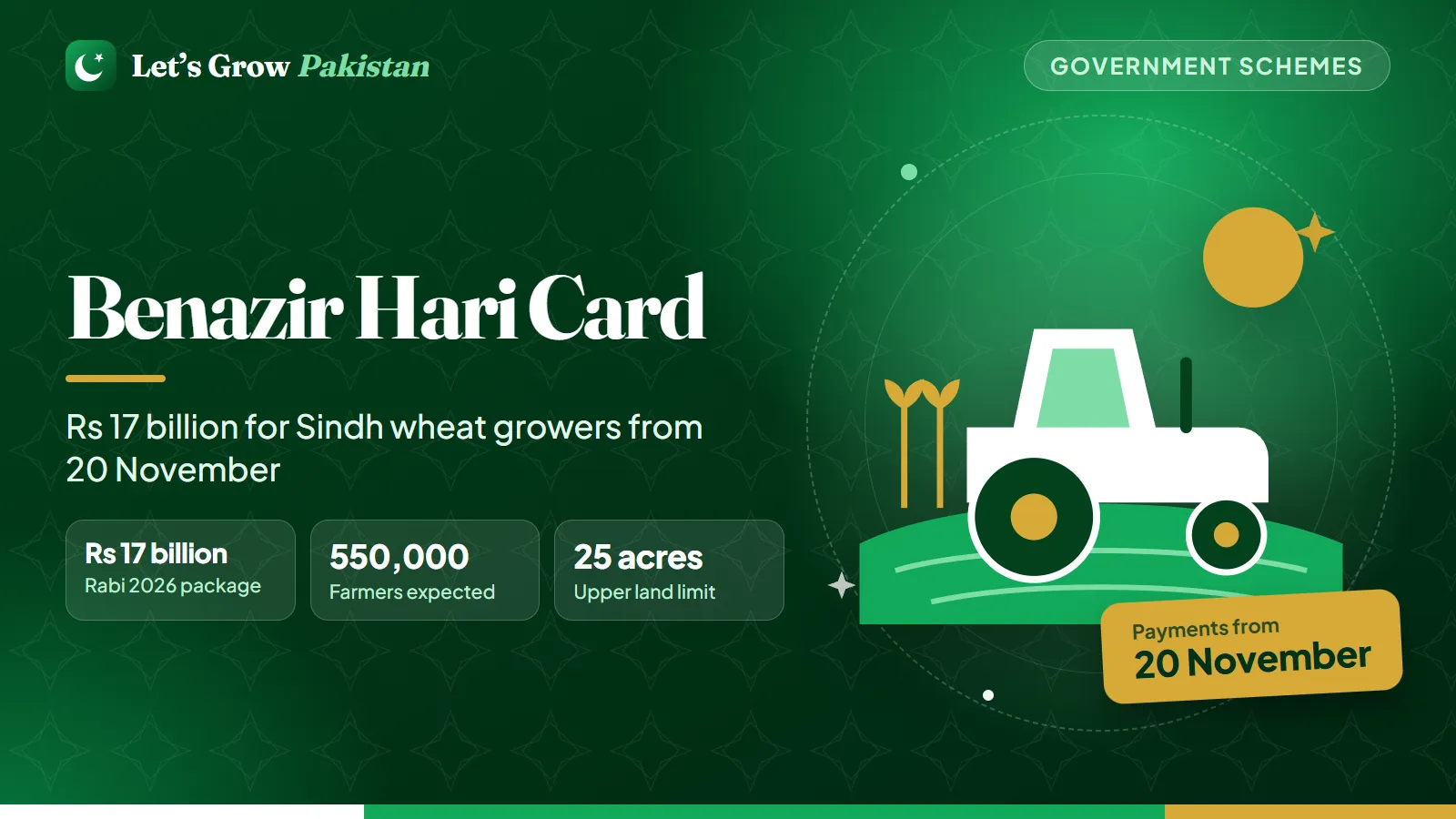
Sindh starts paying Rs 17 billion to wheat growers on 20 November 2026, and the money goes only to Benazir Hari Card accounts. If you hold 25 acres or less and are not yet verified, registration is the step that decides whether you are paid.
- Rs 17 billion
- Package, Rabi 2026
- 550,000
- Farmers expected
- 25 acres
- Land limit
- Rs 2,000
- Extra per maund sold to Food Dept
Hari card payment for wheat 2026
The Sindh cabinet approved this season’s wheat package on 18 September 2026. Its first estimate was Rs 14.9 billion. With the procurement incentive, the cabinet said the total could reach about Rs 16 billion. By November the Agriculture Department was citing Rs 17 billion.
| Item | What was approved or announced |
|---|---|
| Programme | Sindh Wheat Growers Support Programme, Rabi 2026 |
| Cabinet approval | 18 September 2026 |
| Who qualifies | Growers with up to 25 acres |
| Main support | Subsidy on DAP fertiliser or an approved alternative |
| Per acre amount | Not published as of 14 November 2026 |
| Procurement bonus | Rs 2,000 per maund sold to the Food Department, up from Rs 1,000 |
| Payment route | Benazir Hari Card account at Sindh Bank |
| Distribution start | 20 November 2026 |
| Farmers expected | About 550,000 |
Rs 17 billion from 20 November
Agriculture Secretary Muhammad Zaman Narejo put the beneficiaries at about 550,000. PPP Chairman Bilawal Bhutto Zardari is to open the distribution at the Chief Minister House in Karachi. District teams have finished technical verification to block fake claims. Facilitation desks are being set up for farmers who missed registration.
DAP subsidy amount per acre
The cabinet approved a DAP subsidy, or an approved alternative, for each eligible grower. It did not publish an amount per acre or per bag. Last season’s figures do not carry over, because the package was redesigned. We will add the rate here once the department publishes it.
Rs 2,000 per maund on Food Department sales
Growers who sell wheat to the Food Department get an extra payment for every maund supplied. The cabinet doubled it from Rs 1,000 to Rs 2,000 per maund. The money depends on the quantity you actually deliver. A farmer selling 100 maunds would earn Rs 200,000 on top of the wheat price, by our arithmetic.
Benazir Hari Card registration
The Agriculture Department runs an online registration form with five parts. Field assistants at agriculture offices also fill it in for farmers who cannot do it themselves.
- 1
Verify your land
Match your Form VII land record with your CNIC at the revenue office.
- 2
Personal details
CNIC, mobile, district, taluka, union council, deh and acres.
- 3
Assets and water
Machinery, livestock, canal or tube well, and energy source.
- 4
Sindh Bank details
Branch, account title, addresses and GPS of the land.
- 5
Upload and submit
CNIC both sides, a photo and Form VII.
What the online form asks
| Part | Fields |
|---|---|
| 1. Personal details | Name, father or husband, CNIC with issue and expiry date, mobile, district down to deh and village, household size, next of kin, house type, total and cultivated acres, survey numbers, tenants and crops |
| 2. Assets | Tractor, plough, thresher, harvester and other machines; livestock and poultry |
| 3. Irrigation | Canal, tube well, rain fed or riverine land; electricity, solar or diesel; watercourse length and lining |
| 4. Bank details | Sindh Bank city and branch, account title, date of birth, mother’s name, addresses, GPS of the land |
| 5. Uploads | CNIC front and back, photo, Form VII (JPG or PNG) |
Re-registration for the wheat programme 2026
Being on the Hari Card list once is not enough. The Chief Minister ordered on 18 September 2026 that eligible growers be re-registered, with tighter digital checks to remove duplicates. The department’s Wheat Subsidy Program 2026 page lists a named officer with a mobile number for every area. Call your area’s officer before you travel to an office.
Documents for hari card registration
Keep these ready before you start:
- original CNIC, valid and not expired
- a clear photo
- Form VII, the land revenue record
- survey numbers of each plot
- the CNIC and mobile number of your next of kin
- the location of your land, for the GPS field
Who can get the Hari Card
The programme is built for small landholders. The rules used for every recent package rest on three checks.
The 1 to 25 acre limit
Farmers holding 1 to 25 acres were covered in the 2025 package, the April 2026 diesel relief and the current wheat package. Holdings above 25 acres are left out. The acreage counted is what the land record shows, not what you farm on lease.
CNIC, bank and land record checks
Each application is matched with the Hari Card database, NADRA CNIC data, the bank account and land revenue records. In November 2025 this check had confirmed 188,000 of about 321,000 applications within weeks. A mismatch in any one of them holds up the payment.
Tenants and sharecroppers
The form records tenants and sharecroppers on your land. Recent packages, though, have been paid by landholding. No decision we found extends the wheat subsidy to landless haris in their own name. Ask the area officer before you register as a tenant.
Hari card check by CNIC
There is no public page or SMS code that shows Hari Card status by CNIC. Status updates come through the helpline, the agriculture office and Sindh Bank.
| Your situation | Where to go |
|---|---|
| Registered, no news | Your area’s agriculture officer from the department list |
| Not sure your form went through | Hari Card helpline 0311 1646111, Monday to Friday, 9 am to 5 pm |
| Land record rejected | The revenue office, to correct Form VII, then the agriculture officer |
| Card or PIN problem | A Sindh Bank branch with your CNIC |
| Payment missing after 20 November | The facilitation desk in your district, then the complaint form |
Hari card complaint
The Hari Card website has a complaints section. The Agriculture Department also runs a complaint form on its own site and answers on 021 99211468 during office hours. Note your CNIC, district and the date you registered before you call.
Fake calls and paid agents
Registration is free. The department has published no SMS code for the Hari Card, so any message asking you to send your CNIC to a short code is fake. Never share your ATM PIN or a one time code with a caller who says he is from the bank.
Hari Card payment through Sindh Bank
Sindh Bank was authorised to make the cards before the October 2024 launch. Every payment since then has gone into these accounts. The bank holds your biometric record, so withdrawals need the card holder in person.
Getting your card
New cards are issued in batches. In October 2025 the government planned 50,000 new cards through Sindh Bank in one month. If your registration is verified but you have no card, ask the branch you chose on the form.
When the money arrives
Payments come in rounds, not monthly. Each round opens with an announcement from the Agriculture Department. For Rabi 2026 the first date is 20 November. Keep your CNIC valid, because an expired card can block a withdrawal.
What the Hari Card paid before
The card has carried three different payments in two years. Each had its own rate and rules.
Business Recorder, October 2024; APP, 9 November 2025; Sindh government, 10 April 2026; Agriculture Department, 11 November 2026.
Wheat package 2025 to 2026
In October 2025 Sindh announced Rs 55.9 billion for small wheat growers. Each grower was to get one bag of DAP and two bags of urea per acre. Press reports valued this at about Rs 24,700 per acre. DAP was paid in November 2025, and urea from 20 January 2026 after crops were checked. That package has ended.
Diesel relief in April 2026
On 8 April 2026 the Chief Minister approved Rs 3 billion to offset diesel costs at harvest. The rate reported was Rs 1,500 per acre for growers with 1 to 25 acres. Senior Minister Sharjeel Memon said on 10 April that 331,000 farmers had been paid through the Hari Card.
Wheat procurement from Hari Card holders
For the first time, Sindh bought wheat in April 2026 only from registered Hari Card holders. The price was Rs 3,500 per 40 kg. The Chief Minister later said 56,741 farmers supplied over 2.04 million maunds in that season.
- Oct 2024Card launched
Bilawal Bhutto Zardari handed the first cards to farmers.
- Oct 2025Rs 55.9 billion wheat package
One DAP and two urea bags per acre for 1 to 25 acre growers.
- 10 Nov 2025Registration closes
About 321,000 farmers registered after an extension.
- Apr 2026Diesel relief and procurement
Rs 1,500 per acre, and wheat bought only from card holders.
- 18 Sep 2026New package approved
DAP subsidy and Rs 2,000 per maund for up to 25 acres.
- 20 Nov 2026Payments begin
Rs 17 billion for about 550,000 farmers.
Hari Card and Punjab’s Kisan Card
The two farmer cards are often mixed up in searches. They work in very different ways.
| Benazir Hari Card (Sindh) | Kisan Card (Punjab) | |
|---|---|---|
| What you get | A grant: subsidy paid into your account | An interest free loan for inputs |
| Repayment | None | Yes, after harvest |
| Land limit | Up to 25 acres | Up to 25 acres |
| Bank | Sindh Bank | Bank of Punjab |
| How to apply | Online form or agriculture officer | SMS to 8070 |
Punjab growers should read the Kisan Card guide instead. Balochistan farmers have their own Benazir Kissan Card.
Other help for Sindh farm families
The Hari Card covers the farmer only. A low income household can also check the federal BISP 8171 programme. Every other farm and family programme sits in the schemes directory.
Where these facts come from
The 2026 package details come from the Sindh cabinet meeting of 18 September 2026 and the Agriculture Department briefing of 11 November 2026. Registration fields are from the official Hari Card form. Earlier rounds are from Sindh government statements reported by the state news agency, including the November 2025 registration update. All were checked on 14 November 2026.
Frequently asked questions
How much is the Benazir Hari Card wheat subsidy in 2026?
The Rabi 2026 package is about Rs 17 billion for some 550,000 farmers. It covers a DAP subsidy for growers with up to 25 acres. The per acre amount had not been published by 14 November 2026.
How do I register for the Benazir Hari Card?
Fill in the five part online form on the Hari Card portal, or ask your area's agriculture officer. You need your CNIC, a photo, the Form VII land record and a Sindh Bank branch choice.
How can I check my Hari Card status by CNIC?
No public page shows Hari Card status by CNIC. Call the helpline on 0311 1646111 between 9 and 5 on weekdays, or ask the agriculture officer who registered you.
When will the Hari Card payment come?
The Sindh agriculture minister said distribution starts on 20 November 2026 with a ceremony at the Chief Minister House in Karachi. Money then goes to verified Hari Card accounts at Sindh Bank.
Who is eligible for the Benazir Hari Card?
Sindh farmers holding 1 to 25 acres are eligible, once their CNIC, bank account and land revenue record pass verification. Existing card holders must be re-registered for each new wheat programme.
Last updated: