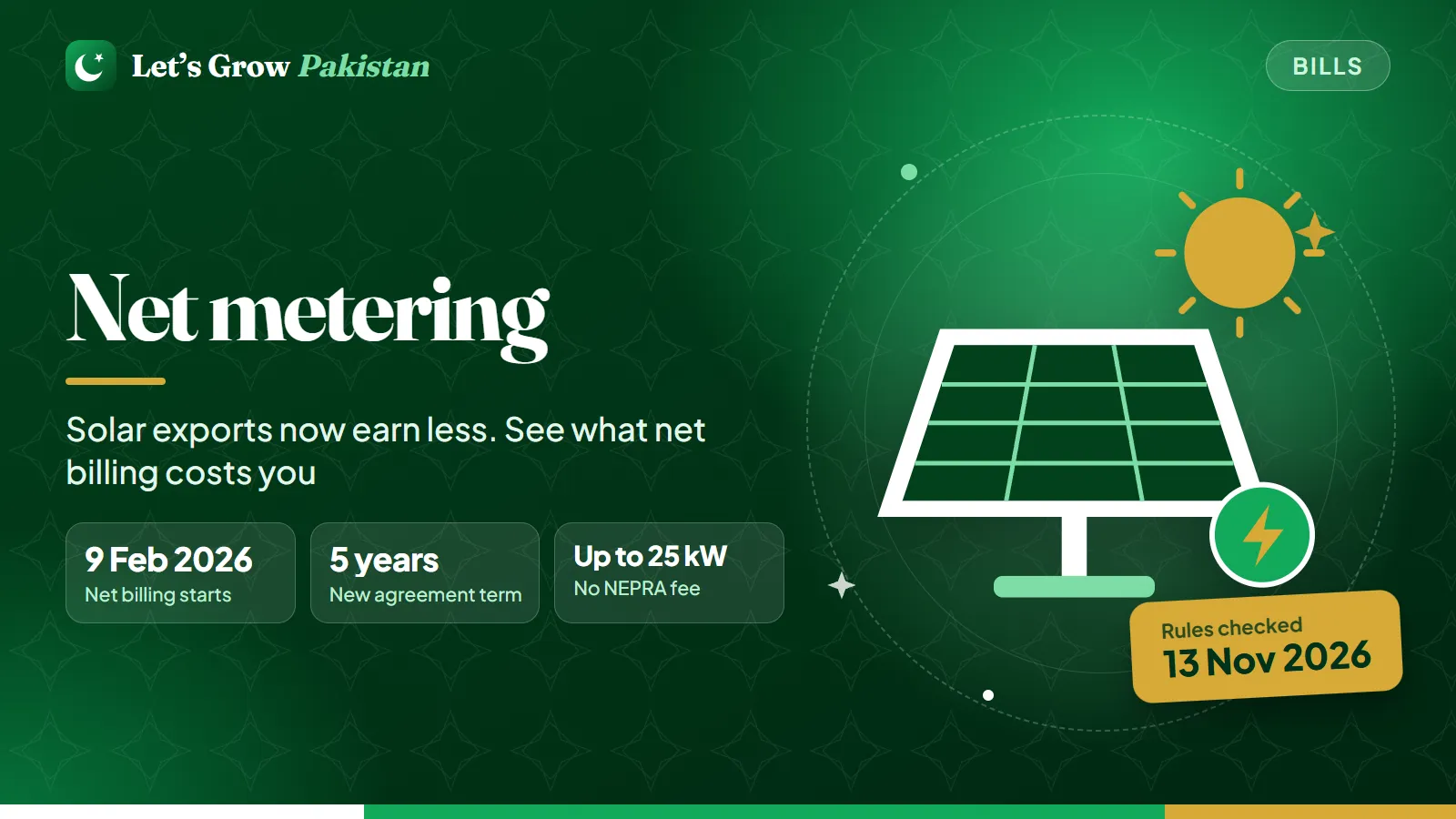
New solar users no longer swap units one for one with the grid. Since 9 February 2026 every exported unit is bought at a much lower rate, while homes that signed earlier keep their net metering deal until it ends.
- 9 Feb 2026
- Prosumer Regulations in force
- About Rs 11
- Reported buyback per unit
- 5 years
- New agreement term
- 80%
- Transformer limit for new solar
- 354,852
- Net metered systems, May 2025
Net billing vs net metering
NEPRA notified the Prosumer Regulations 2026 as S.R.O. 251(I)/2026 on 9 February 2026. They repealed the net metering rules of 2015 and came into force at once.
How net metering worked
The Power Division’s billing guide still describes the old system. A bidirectional meter counted units in and out. Exported units were set against the next month’s use, and any surplus was settled every quarter. In effect, a unit sent to the grid cancelled a unit taken from it.
How net billing works now
Regulation 14 splits the two flows. Every unit you take from the grid is billed at the normal tariff. Every unit you send is credited at the national average energy purchase price. If your credit is larger than your bill, it moves to the next bill or is paid to you quarterly. NEPRA can change the buyback rate during the agreement, and the new rate then applies to you.
A 10 kW home in one month
| Monthly reading | Units | Net metering | Net billing |
|---|---|---|---|
| Imported from the grid | 600 | 200 net units at Rs 34.53 | 600 units at Rs 34.53 |
| Exported to the grid | 400 | Cancels 400 imported units | 400 units at Rs 11 |
| Energy charge | Rs 6,906 | Rs 16,318 |
That is Rs 9,412 more a month, or about Rs 112,944 a year, before tax and fixed charges. The example uses the off peak ToU rate and the reported buyback rate.
Our calculation: off peak rate Rs 34.53 from S.R.O. 279(I)/2026, buyback Rs 11 as reported in February 2026. Energy charge only.
A home that exports more than it imports still pays something under net billing. At 300 units in and 700 out, the old rules gave a credit of about Rs 10,400. The new rules leave a bill of about Rs 2,659.
What else changed
| Rule | Net metering, 2015 rules | Net billing, 2026 rules |
|---|---|---|
| Exported units | Set against imported units | Paid at the energy purchase price |
| Agreement term | 7 years | 5 years, renewable by both sides |
| Solar size | Larger systems were allowed | Up to your sanctioned load |
| NEPRA fee | None up to 25 kW | None up to 25 kW, Rs 1,000 per kW above |
Existing net metering users
The first version of the rules moved old users onto net billing from the next billing cycle. That did not last.
Agreements signed before 9 February 2026
The prime minister ordered a review, and the Power Division filed a review petition. NEPRA then rewrote regulation 21. A home with a valid agreement under the old rules is billed at the old rate and by the old method until the agreement expires. The change is backdated to 9 February 2026, so it also covers the bills issued in between.
Applications filed by 8 February
On 20 February 2026 the Power Minister told every company, K-Electric included, to honour applications filed before the cut off. About 5,165 consumers had applied for roughly 250.8 MW by then. Those homes are connected under the net metering rules once the company verifies their papers.
When your agreement ends
An old agreement cannot be extended on old terms. When it expires, any renewal follows the 2026 rules, which means net billing and a 5 year term.
Changing your system
The agreement asks for at least 40 working days’ notice before any change that alters the system’s maximum output or its connection equipment. Ask your company in writing which rules a larger system would fall under before you buy panels.
Net billing rate and buyback price
National average energy purchase price
The buyback rate is not set company by company. It is the national average energy purchase price, the fuel and energy part of what power companies pay generators. When the rules were notified, it was reported at about Rs 10 to Rs 11 a unit.
The old rate for surplus units
Under the old rules, units exported beyond your own use earned about Rs 26 each. That followed the national average power purchase price, which NEPRA set at Rs 25.98 a unit for 2025 to 2026.
Import rates a solar home pays
| Tariff under S.R.O. 279(I)/2026 | Rate per unit |
|---|---|
| Peak hours, ToU meter (5 kW and above) | Rs 46.85 |
| Off peak hours, ToU meter | Rs 34.53 |
| 301 to 400 units, unprotected | Rs 36.46 |
| Above 700 units | Rs 47.20 |
These are base rates before GST, the fuel adjustment and other levies. The gap between Rs 11 and these rates is the whole story of net billing.
Using more of your own solar
Every unit used at home is worth more
Under net billing a unit you use yourself saves the full import rate. A unit you export earns about Rs 11. At the off peak rate, each unit moved from export to home use is worth about Rs 23.53. At the peak rate it is worth about Rs 35.85.
Size the system to your daytime load
Run the washing machine, water pump, iron and air conditioners while the panels produce. A smaller system that covers your daytime use now pays back faster than a large one built to export.
Net metering application process
Who can apply
The rules cover three phase consumers at 400 V or 11 kV with solar, wind or biogas systems from 1 kW to 1 MW. Domestic, commercial, industrial, agricultural and general services consumers all qualify. The system cannot exceed the sanctioned load, and a transformer already at 80% solar takes no new applications.
Deadlines NEPRA sets for your company
- 2 working daysForms on request
The company must give you the approved forms free of cost.
- 5 working daysAcknowledgement
The company confirms receipt and lists anything missing. You then have 3 working days to supply it.
- 15 working daysInitial review
A technical check of your site. A refusal must come with reasons within 3 more working days.
- 7 working daysAgreement
You sign the 5 year agreement, and a copy goes to NEPRA.
- 7 + 7 working daysEstimate and payment
The company issues the connection charge estimate, and you pay it within 7 working days.
- 15 working daysMeter and connection
The interconnection and meter are installed after payment.
NEPRA concurrence and fee
The 2026 rules first sent every system to NEPRA for concurrence, with a fee of Rs 1,000 per kW. On 28 April 2026 NEPRA withdrew the licence and the fee for systems up to 25 kW, backdated to 9 February. Larger systems still pay Rs 1,000 per kW, and NEPRA aims to decide within 7 working days. A system of 250 kW or more also needs a load flow study by the company or a consultant registered with the Pakistan Engineering Council.
This PTV News discussion from April 2026 covers the withdrawal of the fee for small systems and what it means for home solar.

Net metering cost on the WAPDA side
| Item | Owner supplied market figure, 13 November 2026 |
|---|---|
| Meter installation, demand notice, wire, connection and file | About Rs 100,000, installed |
| Solar panels, batteries, inverter and other solar equipment | Not included |
This is what homes report paying the company side for the whole net metering connection. Costs vary by company and area, and it is not an official NEPRA or company rate. The NEPRA fee above applies only to systems larger than 25 kW.
Net metering documents
What the application form asks
The form in the regulations asks for your connection details, expected yearly use and production, the inverter’s make and ratings, and the installer firm’s name and contact. Both you and the installer sign it.
Affidavit and agreement
Systems that need NEPRA’s concurrence also send the signed agreement, proof of the fee and an affidavit from you. The agreement follows NEPRA’s standard format, so its terms are the same at every company.
Green meter and inverter
The green meter people talk about is the bidirectional meter that records import and export separately. The rules also allow two separate meters. If the company store has no meter, the Power Division’s guide says the company issues an NOC to buy one from the maker. The same guide asks for a three phase inverter and rules out hybrid inverters.
Certified solar installers
PPIB took over from AEDB
Installer certification moved from the Alternative Energy Development Board to the Private Power and Infrastructure Board. By mid 2025, NEPRA’s State of Industry report counted 743 certified installers and vendors. It also counted 354,852 net metered systems with 5,484 MW.
Before you sign with an installer
Ask for the certificate and check the firm’s name against the one on your application form. The installer’s signature on that form makes the firm answerable for the technical details.
Net metering by company
The rules are the same for every former WAPDA company. What differs is where you apply and how fast each one works.
| Company | Where to start | Our guide |
|---|---|---|
| LESCO | Online system used by authorised firms | LESCO bill |
| MEPCO | E-Ops and customer facilitation centres | MEPCO bill |
| IESCO | Customer facilitation centre | IESCO bill |
| FESCO | Subdivision, with papers on its website | FESCO bill |
| GEPCO | PITC Net Metering Portal, nmp.pitc.com.pk | GEPCO bill |
| PESCO, HESCO | Roshan Pakistan net metering portal | PESCO bill, HESCO bill |
| TESCO | Its published net metering SOP | TESCO bill |
| K-Electric | K-Electric’s own net billing application | Separate process |
LESCO net metering
LESCO has the most solar on its network. It reported 2,053 MW of net metering capacity across 135,837 connections as of May 2026. Applications are filed online, mostly by the installer on your behalf.
MEPCO net metering
MEPCO’s annual report lists net metering among the requests handled by its E-Ops system, alongside new connections and load changes. You can also start at a customer facilitation centre in Multan, Bahawalpur or any other circle.
IESCO net metering
IESCO handles customer requests through its Smart App, the Power Smart App and its facilitation centres. Its network in Islamabad, Rawalpindi and the Potohar districts has one of the larger shares of rooftop solar in the country.
FESCO and GEPCO net metering
FESCO keeps net metering papers, including the 2022 amendment to the old rules, on its website. Read them before you apply at your subdivision. GEPCO, with about 0.6 GW of registered solar, links the PITC Net Metering Portal at nmp.pitc.com.pk from its website.
PESCO, HESCO and TESCO net metering
PESCO and HESCO send solar applicants to the Roshan Pakistan net metering portal, and PESCO publishes its own SOP. TESCO, which serves the merged districts from WAPDA House in Peshawar, publishes a net metering SOP on its website. QESCO posts its SOP, checklist and feeder list, as our QESCO bill guide shows.
pv magazine analysis of NEPRA data, October 2026. National total 6.1 GW across 378,339 consumers on 30 June 2025. LESCO itself reported 2,053 MW by May 2026.
K-Electric is different
K-Electric is licensed by NEPRA and follows the same Prosumer Regulations. It runs its own application form and process in Karachi, though, just as the K-Electric bill runs on its own system. NEPRA has already told it to stop refusing applications on the grounds of overloaded transformers and to upgrade them instead.
Before you buy a solar system
Check three things first
- 1
Sanctioned load
Read it on your bill. Your system cannot be larger, so apply for a load increase first if needed. Our new connection guide explains load changes.
- 2
Phase
Net billing is written for three phase connections. A single phase home needs a phase change before it applies.
- 3
Your daytime use
Size panels to what the house uses while the sun is up. Exports now earn far less than imports cost.
Related guides
A home without a meter yet starts with a new electricity connection. For government help with panels, our solar panel scheme guide lists every programme, and all company bill pages sit on the bills hub.
Sources and last check
Official documents
The rules, deadlines, fees and billing method come from S.R.O. 251(I)/2026, dated 9 February 2026, and NEPRA’s draft amendment to regulation 21 of February 2026. Installer and system counts come from NEPRA’s State of Industry report for 2025. The old process and meter rules come from the Power Division’s billing guide. Import rates come from S.R.O. 279(I)/2026. Company routes come from the GEPCO, TESCO, PESCO, HESCO and FESCO websites and MEPCO’s annual report.
Reports
The buyback and old export rates were reported by Dawn on 10 February 2026. The amendment for existing users was reported on 3 April 2026. Dawn reported the fee withdrawal on 28 April 2026 and the pending applications decision on 20 February 2026. LESCO’s figures were reported on 24 June 2026, and the capacity chart comes from pv magazine on 9 October 2026. The WAPDA side cost is an owner supplied market figure from 13 November 2026. All were checked on 13 November 2026.
Frequently asked questions
Is net metering still available in Pakistan?
Not for new applicants. Applications made from 9 February 2026 get net billing under NEPRA's Prosumer Regulations 2026. Homes with an agreement signed earlier stay on net metering until that agreement expires, and applications filed by 8 February are being processed under the old rules.
What is the net billing buyback rate per unit?
Exported units are bought at the national average energy purchase price, which was reported at about Rs 10 to Rs 11 a unit when the rules were notified. NEPRA can revise it during the agreement, so check the rate printed on your own agreement.
Do I need a NEPRA licence for a 10 kW solar system?
No. In April 2026 NEPRA withdrew the licence and the Rs 1,000 per kW fee for systems up to 25 kW, backdated to 9 February. Systems above 25 kW still pay the one time fee of Rs 1,000 for each kW.
Can I install more solar than my sanctioned load?
No. The 2026 rules cap the solar system at the sanctioned load of your premises. A company also stops taking applications on a transformer once solar on it reaches 80% of its capacity. Raise your sanctioned load first if you need a bigger system.
How long does net metering take after I apply?
NEPRA sets a deadline for each step. The company gets 5 working days to acknowledge, 15 for the review, 7 for the agreement, 7 for the estimate and 15 to install after you pay. In practice companies often take longer, so keep every receipt and date.
Last updated: