Enter your reference number in the box above to pull up this month’s bill. The estimator below shows what any number of units would cost at the rates notified for November 2026.
IESCO’s official channel posted this 106 second clip on 25 October 2024. It walks through the IESCO Smart App, which shows the bill, takes payments, registers complaints and lists outage schedules.

The app needs the same reference number as the box above. The rest of this page explains what you see once the bill opens.
Reading an IESCO bill line by line
An IESCO bill packs a lot into small boxes. Four of them settle most arguments about a high bill.
Meter reading date in column 9
IESCO’s own FAQ says meters are read every month on the date printed in column 9 of the bill. If that date passed and no one came, tell your subdivision. An estimated reading is the most common cause of a sudden jump.
Units and the last six months
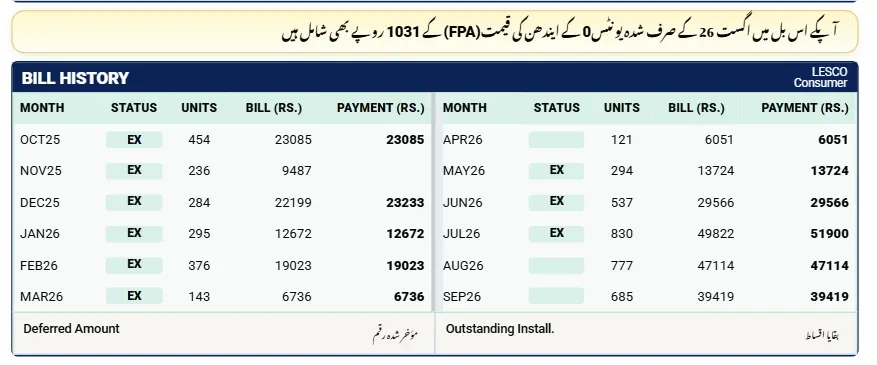
The bill prints the units for this month and a short history. Read the history before you call. It also tells you whether you have stayed under 200 units for six months, which decides protected status.
Your customer services office in column 34
The office that handles your account is printed in column 34. That is where a correction, an installment request or a meter complaint goes first.
The feeder name
Every bill names the 11 kV feeder that supplies your street. You need it to read the load shedding and maintenance schedules further down this page.
Arrears that should not be there
If an old bill was paid but shows again as arrears, IESCO asks you to bring the bank receipt of that bill. Show it at the subdivision, a customer service centre or the bank branch, and the arrears are corrected.
IESCO bill check by reference number or Customer ID
The box at the top fetches your bill from the official IESCO Web Bill service run by PITC. It opens on this page, where you can zoom, copy the image, save it as PNG, JPG or PDF, print it or share it.
The reference number in four boxes
| Box | Digits | What it stands for |
|---|---|---|
| Batch | 2 | Your billing batch |
| Subdivision | 5 | The IESCO subdivision office |
| Reference | 7 | Your own connection |
| Letter | 1 | U for urban, R for rural |
The 10 digit Customer ID
Each bill also carries a Customer ID. It opens the same account, so use it when the reference number is torn or smudged. Do not type it into the reference boxes.
U or R decides the result
A rural connection must be searched with R. With the wrong letter, the service simply reports that no bill was found.
When last month’s bill appears
If the old month shows, the new bill has not been uploaded yet. Bills usually appear a few days before the due date, so try again the next day.
IESCO bill calculator for common unit counts
These are our estimates from the notified rates, with the November 2026 fuel and quarterly adjustments included. They leave out arrears, meter rent and income tax.
Lifeline homes up to 100 units
| Units | Load | Status | Estimated bill | Per unit |
|---|---|---|---|---|
| 50 | 1 kW | Lifeline | Rs 233 | Rs 4.66 |
| 90 | 1 kW | Lifeline | Rs 822 | Rs 9.13 |
Lifeline homes pay no fixed charge and no fuel adjustment. Between 51 and 100 units, every unit moves to Rs 7.74, which is why 90 units cost more than three times 50.
Protected homes up to 200 units
| Units | Load | Estimated bill | Per unit |
|---|---|---|---|
| 120 | 1 kW | Rs 2,374 | Rs 19.79 |
| 150 | 2 kW | Rs 3,306 | Rs 22.04 |
| 199 | 2 kW | Rs 4,250 | Rs 21.36 |
Two units that cost Rs 5,877
At 199 units a protected 2 kW home pays about Rs 4,250. The same home at 201 units, once it has lost protection, pays about Rs 10,127. Every one of the 201 units is then billed at Rs 33.10 before charges.
Larger homes in the city sectors
| Units | Load | Status | Estimated bill | Per unit |
|---|---|---|---|---|
| 250 | 2 kW | Unprotected | Rs 12,395 | Rs 49.58 |
| 350 | 3 kW | Unprotected | Rs 19,000 | Rs 54.29 |
| 450 | 3 kW | Unprotected | Rs 25,700 | Rs 57.11 |
| 600 | 4 kW | Unprotected | Rs 35,992 | Rs 59.99 |
| 800 | 4 kW | Unprotected | Rs 53,517 | Rs 66.90 |
Our calculation from NEPRA S.R.O. 279(I)/2026, 1501(I)/2026 and 2094(I)/2026. Excludes income tax, arrears and meter rent.
Inside a 350 unit bill
A 3 kW home using 350 units, unprotected, breaks down like this.
| Line on the bill | Amount |
|---|---|
| Energy, 350 units at Rs 36.46 | Rs 12,761 |
| Fixed charge, Rs 400 per kW for 3 kW | Rs 1,200 |
| FC surcharge, Rs 3.23 per unit | Rs 1,131 |
| Quarterly adjustment, Rs 0.5194 per unit | Rs 182 |
| Fuel adjustment, Rs 2.3673 per unit | Rs 829 |
| GST at 18% | Rs 2,898 |
| Estimated total | Rs 19,000 |
Where the taxes start to bite
GST alone is about 15% of that total. Bills from 450 units up pass Rs 25,000, where advance income tax can apply to anyone not on the Active Taxpayers List.
IESCO unit rate and slabs for November 2026
IESCO charges the national uniform tariff notified as S.R.O. 279(I)/2026, in force since 12 February 2026. The same slab rates apply in Islamabad, Rawalpindi and the rest of the country. A Gujranwala home on a GEPCO bill or a Faisalabad home on a FESCO bill pays the same rates. So does a Peshawar home on a PESCO bill.
Lifeline and protected slab rates
| Group | Units in the month | Rate per unit | Fixed charge per kW |
|---|---|---|---|
| Lifeline | Up to 50 | Rs 3.95 | None |
| Lifeline | 51 to 100 | Rs 7.74 on every unit | None |
| Protected | 1 to 100 | Rs 10.54 | Rs 200 |
| Protected | 101 to 200 | Rs 13.01 | Rs 300 |
Unprotected slab rates
| Units in the month | Rate on every unit | Fixed charge per kW |
|---|---|---|
| 1 to 100 | Rs 22.44 | Rs 275 |
| 101 to 200 | Rs 28.91 | Rs 300 |
| 201 to 300 | Rs 33.10 | Rs 350 |
| 301 to 400 | Rs 36.46 | Rs 400 |
| 401 to 500 | Rs 38.95 | Rs 500 |
| 501 to 600 | Rs 40.22 | Rs 675 |
| 601 to 700 | Rs 41.85 | Rs 675 |
| Above 700 | Rs 47.20 | Rs 675 |
Fixed charge follows sanctioned load
The fixed charge is rupees per kW of sanctioned load, picked by the slab your units fall in. A 2 kW home at 250 units pays Rs 350 times 2, or Rs 700, before GST. Your sanctioned load is printed on the bill.
Time of use meters from 5 kW
A load of 5 kW or more must be on a time of use meter. Peak units cost Rs 46.85 and off peak units Rs 34.53. The fixed charge is Rs 675 per kW on half the load or the MDI, whichever is higher.
Minimum charge for lifeline meters
Where no fixed charge applies, a minimum monthly charge is billed instead. It is Rs 75 on single phase and Rs 150 on three phase.
Protected consumer rules on IESCO bills
The six month test
A home is protected while it uses 200 units or less in each of the last six months. IESCO decides this from its own readings, not from a form you fill in.
One previous slab benefit
Protected homes pay in steps. At 180 units, the first 100 cost Rs 10.54 each and the other 80 cost Rs 13.01 each. Unprotected homes pay one rate on every unit.
Losing and getting back protection
One month above 200 units ends protection. It comes back only after six straight months at 200 units or below, so a single hot June can cost you through December.
Lifeline homes pay less again
Lifeline homes using up to 100 units pay no fixed charge, no fuel adjustment and no quarterly adjustment. They also skip the FC surcharge.
FCA, quarterly adjustment and taxes on IESCO bills
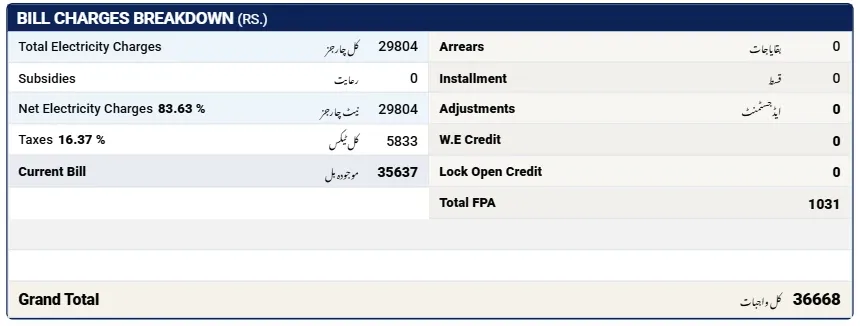
Rs 2.3673 per unit on September units
NEPRA set the September 2026 fuel charges adjustment at Rs 2.3673 per unit on 6 November 2026. The actual fuel cost was Rs 9.8268 against a reference of Rs 7.4596 per kWh. It is billed in November on the units used in September.
FCA over four months
| Fuel month | Per unit | Billed in |
|---|---|---|
| June 2026 | Rs 0.7503 | August 2026 |
| July 2026 | Rs 2.0581 | September 2026 |
| August 2026 | Rs 1.1086 | October 2026 |
| September 2026 | Rs 2.3673 | November 2026 |
Homes that pay the FCA
Every IESCO consumer pays it except lifeline homes, EV charging stations and prepaid meters. Protected homes pay it too.
Quarterly adjustment ends on 30 November
The quarterly adjustment of Rs 0.5194 per unit sits on the September, October and November 2026 bills under S.R.O. 1501(I)/2026. It is valid until 30 November 2026. Lifeline units are exempt.
FC surcharge of Rs 3.23
The financing cost surcharge of Rs 3.23 per unit repays the Rs 1.225 trillion circular debt loan, according to Power Division and Finance Ministry statements. Protected homes are reported to pay Rs 0.43 instead.
18% GST and income tax
GST at 18% is charged on energy, fixed charge, surcharge and both adjustments together. Advance income tax under section 235 can be added once a bill passes Rs 25,000 for anyone not on the Active Taxpayers List.
Lines no longer on the bill
The Rs 35 PTV fee left electricity bills from July 2025. Provincial electricity duty is also no longer collected on domestic bills.
IESCO bill due date and late payment surcharge
At least seven days to pay
The Power Division’s billing guide says consumers get a grace period of at least seven days. The due date printed on the bill is the last day to pay without a surcharge.
10% after the due date
After the due date, 10% of the bill before taxes is added. These sample bills show the difference.
| Sample bill | By due date | After due date | Extra |
|---|---|---|---|
| 120 units, protected, 1 kW | Rs 2,374 | Rs 2,576 | Rs 201 |
| 150 units, protected, 2 kW | Rs 3,306 | Rs 3,587 | Rs 280 |
| 250 units, unprotected, 2 kW | Rs 12,395 | Rs 13,445 | Rs 1,050 |
| 450 units, unprotected, 3 kW | Rs 25,700 | Rs 27,878 | Rs 2,178 |
Disconnection notices
The Power Division lists Rs 500 as the minimum unpaid amount for a disconnection notice. Unpaid bills can lead to disconnection on top of the late fee.
Getting supply back
IESCO reconnects only after the dues are cleared and the Customer Services Officer signs the order. A fresh security deposit at current rates and a new agreement are also required.
IESCO bill payment online and at banks
What every channel asks for
Banks, wallets and counters all ask for the 14 digit reference number. Copy it from the bill on this page instead of typing it from memory.
Bank apps and wallets
Allied Bank announced IESCO bill payment inside its myABL app. Other banking apps and mobile wallets list IESCO under electricity in their bill menus. Match the amount on screen with your bill before you confirm.
IESCO Smart App
IESCO’s app covers bill checking and quick payment along with complaints. It is on Google Play and the App Store, as the video above shows.

IESCO Smart
IESCO's own app for the monthly bill and your connection.


Power Smart
Send a photo of your own meter reading so the bill is made from it, and view the bill.
Keep the receipt
Save the receipt with the month in its file name. IESCO asks for it if arrears ever appear on a paid bill.
IESCO duplicate bill when the paper copy is missing
Download it here
- 1
Open the bill
Enter the reference number or Customer ID in the box at the top.
- 2
Pick a format
PDF suits printing and filing, while PNG or JPG is quicker on a phone.
- 3
Label it
Put the month in the file name so an old bill is never paid twice.
Duplicate at a service centre
IESCO’s FAQ says duplicate bills are also issued at its customer service centres. Take an old bill or the reference number with you.
When bills keep going missing
For repeated non delivery, IESCO asks consumers to contact the subdivision. The Power Division also lists the CCMS portal at ccms.pitc.com.pk for non delivery complaints.
IESCO bill installment rules
Approval limits by amount
IESCO’s own FAQ sets a ladder for installments on arrears.
| Arrears | Approved by | Installments |
|---|---|---|
| Up to Rs 2,000 | SDO | Up to 3 monthly |
| Up to Rs 10,000 | XEN | Up to 3 monthly |
| Up to Rs 100,000 | SE | Up to 4 monthly |
| Above Rs 100,000 | Chief executive | Up to 6 monthly |
Conditions that apply
You must not have defaulted in the last six months, and you sign a written undertaking. Installments on arrears carry interest at the prevailing bank rate.
The running bill and the 2023 order
The FAQ says installments are not allowed on a running bill. In August 2023, after protests over high bills, Radio Pakistan reported that IESCO’s chief executive told all offices to offer installment plans to consumers who visit in person. Ask your customer services office which rule applies to your bill.
Missing an installment
A missed installment can lead to disconnection. Supply returns after the first installment is paid and the other formalities are done.
Wrong IESCO bill, meter reading and detection bills
Overbilling and the meter photo
Meter readers record the reading on a handheld device or phone and take a photo of the meter. Compare the reading on your bill with your own meter display before you complain.
Detection bills
IESCO issues detection bills for illegal abstraction, direct hooking or a slow meter. Take the bill to the officer named on it if the units look wrong, and keep paying the running bill.
A defective meter
A faulty meter is billed as “def est”, based on your units in the same months last year. IESCO says a new meter should come within two to three months, and the subdivision is the place to chase it.
Slab benefit after under billing
When earlier months were under billed and the units are charged later, IESCO says the slab benefit is applied automatically. Check that the units were spread over the right months.
IESCO complaint number and helpline 118
Call 118 or SMS 8118
IESCO’s homepage lists 118 for customer care and 8118 for SMS. The official channel ran a short 118 helpline campaign in October 2026.
Head office
IESCO’s head office is on Street 40, Sector G-7/4, Islamabad. The main line is 051 9252937.
Chief executive’s open sessions
IESCO’s chief executive takes complaints in Facebook Live e katchery sessions. Press releases announced sessions on 29 April 2026 and 28 August 2026.
When IESCO does not resolve it
NEPRA’s Asaan Approach app takes complaints against any distribution company. Keep the reference number, complaint number and date ready.
- 426,240
- Complaints received
- 116
- Complaint centres
- 10.07
- Complaints per centre a day
IESCO load shedding and shutdown schedule
The monthly schedule by circle
IESCO’s load shedding page posts a spreadsheet for each circle, dated November 2026. The rows cover Islamabad, Rawalpindi City and Cantt, Attock, Jhelum and Chakwal, plus AJK.
Finding your feeder
Open the file for your circle and search for the feeder name printed on your bill. Hours differ by feeder, so the city name alone is not enough.
Maintenance shutdowns to 8 February 2027
IESCO’s annual maintenance programme runs from 15 October 2026 to 8 February 2027. It covers 132 kV grid stations, transformers and more than 1,295 feeders of 11 kV. Short planned shutdowns are needed on the feeders being worked on.

The 80 second announcement asks consumers to check the advance schedule for their feeder on the IESCO website, its social pages or the 118 helpline.
IESCO new connection through e-OPS
Where to apply
IESCO has moved new connection requests from ENC to its e-OPS system. Apply through the IESCO Smart App, the Power Smart App or the nearest Customer Facilitation Centre.
The application form and survey
New connections and load extensions use IESCO’s Application and Agreement form. A company representative then visits for a site survey and collects the paper documents.
Costs listed by the Power Division
| Connection | Material up to 40 m | 40 to 100 m | Security, urban | Security, rural |
|---|---|---|---|---|
| Single phase, 3 kW | Rs 4,000 | Rs 200 per m | Rs 3,660 | Rs 1,830 |
| Three phase, 5 kW | Rs 15,000 | Rs 260 per m | Rs 6,100 | Rs 3,050 |
These are the Power Division’s published figures. The demand notice IESCO issues for your address is the amount you actually pay.
Name change, shifting and load change
A name change follows the same process as a new connection. Shifting and a change of tariff are allowed where technically feasible. A load reduction does not require paying a security deposit difference.
IESCO net metering and net billing
What changed in February 2026
NEPRA’s Prosumer Regulations 2026 came into force on 9 February 2026 and replaced net metering with net billing for new users. Exported units are bought at a lower rate instead of being swapped one for one.
Existing solar users
After the prime minister ordered a review, NEPRA moved to keep existing users on their old contracts until those contracts expire. Our solar scheme guide covers the change in more detail.
Before you apply to IESCO
The Power Division’s page still describes the older process, with a bi directional meter and a three phase inverter. Ask IESCO which rules your application falls under and what buyback rate it will pay before you size a system.
IESCO area, circles and divisions
Islamabad and four districts
IESCO serves Islamabad Capital Territory and the districts of Rawalpindi, Attock, Jhelum and Chakwal. Its own description runs from Attock to Jhelum and from the Indus towards the Neelum.
Six circles and 20 divisions
| Circle | Divisions | Connections, Oct 2026 |
|---|---|---|
| Attock | Taxila, Attock, Pindi Gheb | 918,489 |
| Rawalpindi Cantt | Pindi Cantt, Tariqabad, Rawat, Mandra | 811,466 |
| Rawalpindi City | Satellite Town, Pindi City, Westridge | 708,723 |
| Islamabad | Islamabad I, Islamabad II, Bhara Kahu | 693,724 |
| Chakwal | Talagang, Chakwal, Pind Dadan Khan, Dhudial | 673,818 |
| Jhelum | Jhelum I, Jhelum II, Gujar Khan | 533,967 |
IESCO consumer profile for October 2026.
Circle lines that cross district lines
Circles do not follow district maps. Gujar Khan, in Rawalpindi district, sits in the Jhelum circle, while Pind Dadan Khan in Jhelum district sits in the Chakwal circle.
Connections by category
- 3,755,922
- Domestic
- 526,150
- Commercial
- 19,767
- Industrial
- 7,637
- Tubewell
IESCO’s consumer profile counts 4,340,187 connections in all. About 86.5% of them are homes.
IESCO next to other distribution companies
Complaints per centre
| Company | Complaints, FY 2024 to 2025 | Complaint centres | Per centre a day |
|---|---|---|---|
| IESCO | 426,240 | 116 | 10.07 |
| GEPCO | 601,592 | 123 | 13.40 |
| FESCO | 688,910 | 341 | 5.54 |
| LESCO | 1,849,061 | 201 | 25.20 |
| MEPCO | 1,951,314 | 190 | 28.37 |
Losses and faults
IESCO reported transmission and distribution losses of 8.39% for FY 2024 to 2025, down from 8.75% a year earlier. NEPRA’s report counts 2.23 faults per km of IESCO line.
Reading the comparison
IESCO had the fewest complaints of the five, even with 4.34 million connections. Its centres handle fewer complaints a day than the LESCO bill or MEPCO bill areas, but more than in the FESCO bill area.
IESCO privatisation and your bill
Ten expressions of interest
The Privatisation Commission received ten expressions of interest for IESCO on the closing date. Bidders want 51% to 100% of the shares with management control. Three named bidders are from Türkiye.
- May 2026Sale opens
Expressions of interest invited for FESCO, GEPCO and IESCO.
- 29 August 2026Deadline moved
The IESCO deadline moved from 7 September to 21 September.
- 21 September 2026Ten bidders
Ten expressions of interest received for IESCO.
- 6 November 2026November FCA
NEPRA set Rs 2.3673 per unit on September units.
What changes for consumers
Nothing on the November bill. NEPRA sets the tariff, and the Commission is still checking the applicants. Sister companies are in the same process, as the GEPCO bill guide shows.
Sources behind the IESCO figures
Rates
Slab rates and fixed charges come from S.R.O. 279(I)/2026. The fuel and quarterly adjustments come from NEPRA notifications from 7 August to 6 November 2026.
IESCO and Power Division
Helplines, circles, connections, installment rules and the load shedding page come from iesco.com.pk. Grace period, meter photos and connection costs come from the Power Division’s billing guide. All were checked on 11 November 2026.
Our arithmetic
Every bill estimate on this page is our own arithmetic from those rates. Other electricity companies have their own bill guides.
Frequently asked questions
How can I check my IESCO bill online?
Type the 14 digit reference number from an old IESCO bill in the box at the top of this page and choose U or R. The current bill opens on this page, ready to save as PDF, print or share.
Can I check my IESCO bill with my CNIC?
No. The official IESCO bill service finds a bill only by the 14 digit reference number or the 10 digit Customer ID. A CNIC, meter number or phone number will not open it, so keep one old bill safe.
What is the IESCO helpline number?
Call 118 from any phone for power failures, bill problems and other complaints. IESCO also lists 8118 as its SMS number, and the head office in G-7/4 Islamabad can be reached on 051 9252937.
Can I pay my IESCO bill in installments?
Yes, for arrears. IESCO's own rules let an SDO allow up to three installments on dues up to Rs 2,000, rising to six installments approved by the chief executive for dues above Rs 100,000.
How much is the late payment surcharge on an IESCO bill?
After the due date, 10% of the bill before taxes is added. On a protected 150 unit bill of about Rs 3,306, that is roughly Rs 280 more, so paying on time matters.
How many units keep an IESCO home protected?
A home stays protected while it uses 200 units or less in each of the last six months. One month above 200 units ends the protection, and the lower slab rates stop for the next six months.
Where can I see the IESCO load shedding schedule?
IESCO posts a monthly schedule for each circle on its load shedding page as a spreadsheet. Find your feeder name on your bill, then open the file for your circle, such as Islamabad or Jhelum.
Last updated: