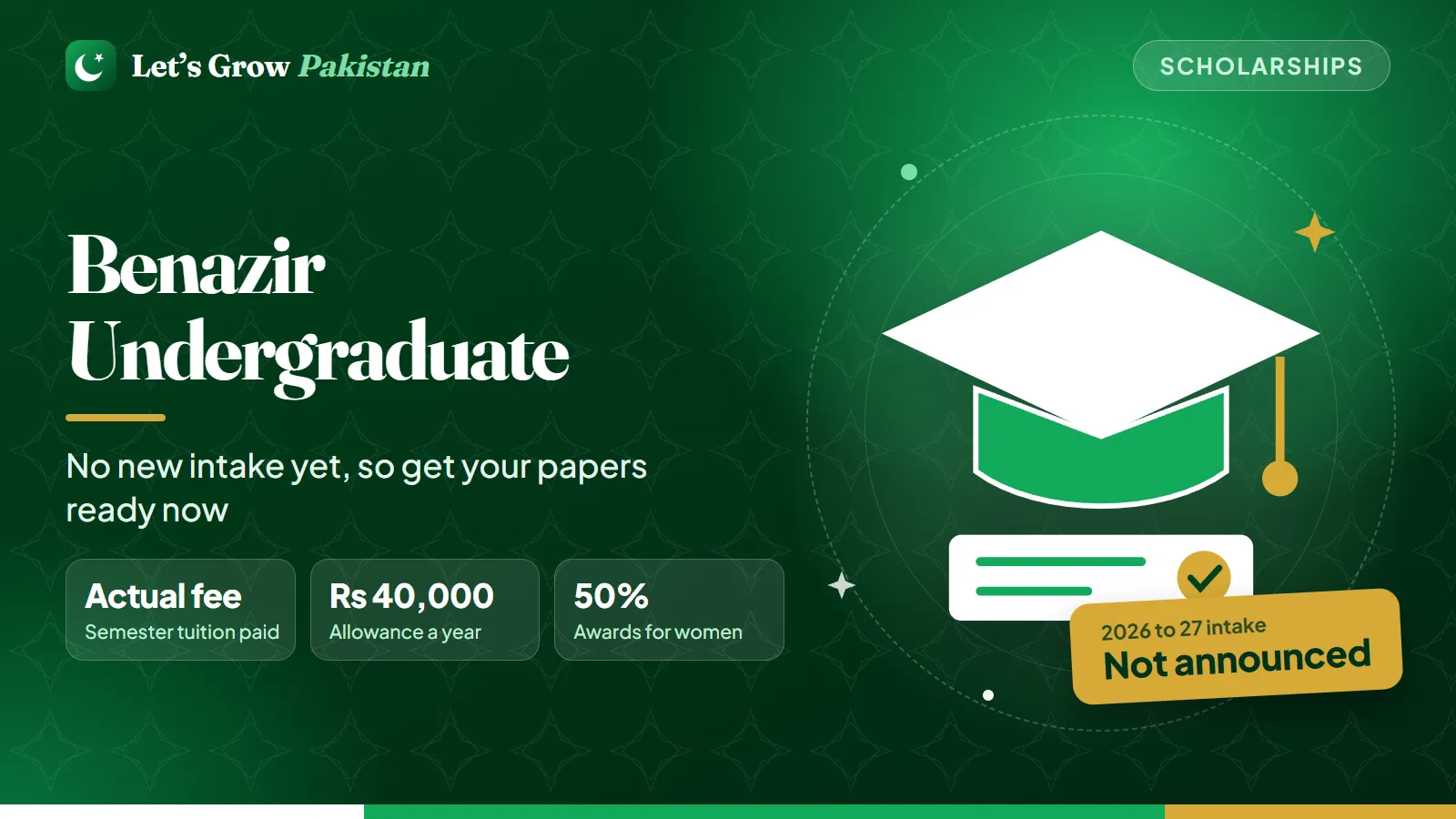
The Benazir Undergraduate Scholarship pays the actual semester tuition plus Rs 40,000 a year, but its HEC portal is closed and no 2026 to 27 intake exists. Universities still pay existing scholars, and the rules for the next call are already public.
- Actual
- Semester tuition fee paid in full
- Rs 40,000
- Yearly allowance listed by HEC
- Rs 45,000
- Monthly family income ceiling (Ministry of PASS)
- 102,003
- Students awarded in three batches
Benazir undergraduate scholarship last date and current status
The Benazir Undergraduate Scholarship has no last date on 19 November 2026, because no new intake has opened. There is no form to fill today, which is the honest answer for a first year student hoping for this award in autumn 2026. A student who prepares the family income papers now is ready the week a call appears.
HEC’s page shows a closed portal and no deadline
HEC’s How to Apply page carries one line on 19 November 2026: the portal is closed. It lists no steps, no session and no deadline. The programme’s eligibility page still names the Fall 2021 session, and its FAQ names Spring and Fall 2020. Those were earlier intakes, and a new call sets its own admission session.
2 dates circulating online have no official notice
Two deadlines circulating online, 31 October and 31 December 2026, have no official notice behind them. Both appear on unofficial guide sites, not on hec.gov.pk or bisp.gov.pk. A genuine call names its own window and admission session.
3 places a new call appears first
A new call appears first in 3 places: HEC’s programme pages, your university’s Financial Aid Office board and the university website. HEC’s FAQ says students apply through the online form on HEC’s Ehsaas portal, then hand a printed copy to their university. Financial aid staff are usually the first people on campus to know.
- HEC programme pages: The How to Apply page carried the steps and the eligible session for past intakes.
- Financial Aid Office board: Each university posts its own notice and collects the hard copies there.
- University website: Scholarship notices for current scholars, such as instalment calls, already appear on university sites.
5 ways to contact HEC and your university
HEC answers Benazir scholarship questions on 4 channels, and your university office handles everything else. The table lists all 5 routes. Keep your CNIC number and university name ready when you call or write.
| Channel | Details |
|---|---|
| HEC phone | 051 111 119 432 |
| HEC mobile | 0334 111 9432 |
| Ehsaas@hec.gov.pk | |
| Online help | onlinehelp.hec.gov.pk |
| In person | Student Financial Aid Office of your university |
Applying has never cost a fee. The form appears only on HEC’s own hec.gov.pk website, and the paper copy goes only to your university. Ignore SMS messages, WhatsApp forwards and look alike sites that promise a seat or ask for a registration charge. Call HEC before sharing a CNIC if a message looks doubtful.
Who qualifies, and the 5 groups left out
New merit students in 4 or 5 year undergraduate programmes at HEC recognised public universities qualify. Age follows the university’s own admission limit. The HEC FAQ says there is no entrance test.
5 seat types that count and 5 that do not
The award covers regular merit seats in 4 or 5 year degrees and excludes 5 groups, from private universities to students already holding a grant. Both lists come from HEC’s eligibility page and FAQ. Each excluded group is named there in plain terms.
What we like
- Newly admitted students at HEC recognised public universities
- Admission secured on merit under the university's criteria
- 4 or 5 year undergraduate degrees in any HEC allowed field
- Family income within the need criteria (Rs 45,000 a month per the ministry)
- Students from every province, AJK and Gilgit-Baltistan
!Watch out for
- Private universities and affiliated colleges, public or private
- Evening, self finance, self support and distance learning programmes
- Two year BA or BSc, associate degree and master's programmes
- Associate degree holders joining a BS in the 5th semester
- Students who already hold another scholarship or grant
Half the awards go to women and 2% to students with disabilities
Half the awards are reserved for female students and 2% for students with disabilities, according to HEC’s objectives page. The programme covers public universities in Islamabad, all four provinces, Azad Jammu and Kashmir, and Gilgit-Baltistan. In the 2020 to 21 round, 42,430 of 111,685 applicants were women, about 38%. Female applicants therefore competed for half the awards while making up well under half the pool.
Family income limit and the need test
The family income limit is Rs 45,000 a month, according to the Ministry of Poverty Alleviation and Social Safety. HEC runs the scholarship with BISP money and judges need from documents, not from a BISP score. Many students assume it is a BISP cash programme, which it is not.
Rs 45,000 a month is the ministry’s ceiling
The ministry, which oversees BISP, sets the ceiling on its programme page. It says selection is “need and merit based”, on the student’s CGPA and family income up to Rs 45,000 a month. The HEC pages do not print that figure. They ask students to meet the need criteria and leave the assessment to the university.
No PMT score or NSER entry is required
No PMT score or NSER registration is required for this award. The Proxy Means Test score decides who gets Benazir Kafaalat and the school stipends under Benazir Taleemi Wazaif. The table sets the two need tests side by side.
| Need test | Benazir Undergraduate Scholarship | Benazir Kafaalat and Taleemi Wazaif |
|---|---|---|
| Who decides | University scrutiny and award committees | BISP, from its registry |
| Evidence | Income certificate, salary slip, utility bills, rent deed, house photo | NSER household survey |
| Score | Income ceiling of Rs 45,000 a month (ministry) | PMT score from 0 to 100 |
| Do you need to be in NSER | Not stated in any official rule | Yes |
| Interview | Yes, at the university | No |
A family that is not on the BISP list can therefore still win this scholarship. A family that is on the list still proves its income on paper. The 8171 check is a separate matter for enrolled households and does not affect this award.
What the scholarship pays each year
The scholarship pays the actual semester tuition fee and Rs 40,000 a year, according to HEC’s financial support page. Hostel, books and transport are not listed as separate items. The allowance is the money meant for those costs.
Tuition paid as actual, plus 3 incidental fees
Tuition is paid “as actual”, so the scholarship follows your real fee. An MBBS seat and a BS Economics seat are paid at different amounts. The ministry’s page adds 3 incidental charges: registration, exam and library fees.
Rs 40,000 a year or Rs 4,000 a month
The allowance is Rs 40,000 a year on HEC’s page and Rs 4,000 a month on the ministry’s page. The table compares the two descriptions line by line. The gap is smaller than it looks.
| Item | HEC page | Ministry of PASS page |
|---|---|---|
| Tuition | Semester fee as actual | Tuition fee covered |
| Other charges | Not listed | Registration, exam and library fees |
| Allowance | Rs 40,000 a year | Rs 4,000 a month |
| Duration | Whole 4 or 5 year degree | 4 and 5 year undergraduate programmes |
Rs 4,000 for ten months gives Rs 40,000, so the two pages likely describe the same payment. Neither says over how many months it is paid. Your university’s Financial Aid Office confirms the instalment schedule on the award letter.
Rs 55,950 for MBBS in one 2026 instalment
A June 2026 instalment list from Peoples University of Medical and Health Sciences, Nawabshah, named Rs 55,950 for MBBS and Rs 90,000 for Pharmacy and Physiotherapy. It was reported as Phase III, 5th instalment. We saw that list through a news site, not on the university’s own website, so treat the amounts as one campus’s example. It is also the most recent instalment list we have seen.
Benazir undergraduate scholarship documents
The hard copy needs 9 standard documents, plus extra proof for 6 family situations. HEC’s FAQ lists both sets. A missing page is the commonest reason a form is turned away.
9 standard documents
The 9 standard documents run from your CNIC to a photo of the house front. Copies are enough for identity papers. Stamp paper is needed only for the income undertaking.
| Document | Notes |
|---|---|
| Your CNIC or B Form | Copy |
| CNICs of father, mother or guardian | If the mother has died, the father’s, a brother’s or a sister’s CNIC may be given |
| Salary slip or income certificate | Father or guardian, and mother |
| Income undertaking | For daily wage workers, shopkeepers and private jobs, on Rs 50 stamp paper |
| Utility bills | Last six months: electricity, gas, telephone, water, where applicable |
| Rent agreement | Only if the house is rented |
| Fee receipts | Your own and your siblings’, where applicable |
| Medical bills | Only if the family has major medical costs |
| Photographs | One passport photo of you, one photo of the house front |
Collect the six months of bills now. They are the papers students most often cannot find in a hurry. Electricity, gas, telephone and water bills all count where the family pays them.
Papers for 6 family situations
HEC’s FAQ names 6 family situations that need their own proof, from a retired father to a mother who has died. Each one replaces or adds to the salary slip. The table lists what HEC asks for in each case.
| Family situation | What HEC asks for |
|---|---|
| Father retired | Pension book or a recent bank statement |
| Daily wage worker or private job | Income undertaking on stamp paper |
| Shopkeeper | Income undertaking plus two photos of the shop |
| Father working abroad | Income certificate in that country’s currency |
| Supported by relatives or friends | Only the amount actually received, not their full income |
| Mother has died | CNIC details of the father, a brother or a sister in her place |
Apply online, then hand in the hard copy
Applying takes 2 stages: an online form on HEC’s portal, then a paper copy to your own university. HEC has used the same process for every intake. Neither stage costs a fee.
6 steps when the portal opens
The 6 steps run from watching for the call to signing the agreement. Each step matches HEC’s past instructions. The order matters, because a saved but unsubmitted form counts as no form.
- 1
Watch for the call
Track the HEC programme page and your university's Financial Aid Office notices. A call names the eligible admission session.
- 2
Fill the online form
Enter personal, family income and academic details on the HEC scholarship portal.
- 3
Submit, do not save
HEC rejects forms left in Saved mode. Submit, then print the submitted form.
- 4
Attach documents
Use the lists above. A missing paper means the form is turned away.
- 5
Hand in the hard copy
Give it to the Student Financial Aid Office of your university. Never send it to HEC or BISP.
- 6
Interview and agreement
Shortlisted students are interviewed. Winners sign an agreement on stamp paper and get the award letter.
A mistake after submission is fixed by hand
A mistake after submission is fixed by hand on the printed form, according to the FAQ. You correct it, sign the change and give proof to the Financial Aid Office. Its staff update the evaluation sheet, and their decision is final. A second online form is not the fix.
6 reasons forms are turned away
Forms are turned away for 6 reasons, each named on HEC’s own programme pages. None of them can be fixed after the deadline. Check them before handing in the file.
| Reason | Where HEC says it |
|---|---|
| Form left in Saved mode, never submitted | How to apply instructions |
| Hard copy posted to HEC or BISP instead of the university | FAQ |
| Missing income, bill or CNIC papers | FAQ documents list |
| Private university, affiliated college, evening or self finance seat | Eligibility page and FAQ |
| Two year BA or BSc, associate degree or master’s programme | FAQ |
| Already holding another scholarship or grant | Eligibility page |
Benazir undergraduate scholarship result and interview
Results come from your university, by notice or letter, because there is no national merit list or HEC result page. Each university runs its own selection. Its committees shortlist, interview and recommend.
3 university bodies decide the award
Three bodies decide the award: the scrutiny committee, the Institutional Scholarship Award Committee and the Financial Aid Office. The scrutiny committee shortlists eligible applicants with complete records. The award committee interviews and recommends, and the Financial Aid Office issues the final award letter. The interview covers the family’s finances, not your subject, so bring the originals of every paper in your file.
3 conditions for keeping the award
Keeping the award depends on 3 conditions: staying at the same university, keeping satisfactory results and giving true income papers. The award cannot move to another university, programme or session. Each new term is paid only if academic performance stays satisfactory. False income papers can lead to disciplinary action and a demand to repay everything received.
9 instalment papers for current scholars
Current scholars submit 9 documents before each instalment, as a July 2023 notice from Government College University Faisalabad shows. Fee vouchers and results cover the last two semesters. A fresh parents’ income certificate repeats the need check each time.
| Document | Purpose |
|---|---|
| Paid fee vouchers, last two semesters | Proof of the fee to reimburse |
| Result notifications, last two semesters | Proof of satisfactory progress |
| Student CNIC and student card | Identity |
| Father’s or guardian’s CNIC | Identity of the family |
| Bona fide certificate from the department | Proof you are still enrolled |
| Agreement deed on Rs 50 stamp paper | The scholarship contract |
| Signed award letter declaration | Acceptance of terms |
| Cheque book copy | Bank account for payment |
| Latest parents’ income certificate | Need is checked again |
The University of Veterinary and Animal Sciences, Lahore, posted a notice for Batch II and III disbursement on 2 June 2025. A late instalment goes first to your Financial Aid Office. That office receives the HEC funds and pays scholars.
102,003 students in 3 batches since 2019
The programme has reached 102,003 students in 3 batches since its launch on 4 November 2019, according to the Ministry of PASS. It began as the Ehsaas Undergraduate Scholarship. It was later renamed after Benazir Bhutto, and HEC’s pages now call it BISP Scholarships for Undergraduates.
A plan of 200,000 awards against 102,003 made
The plan at launch was 200,000 awards over four years, about twice the 102,003 the ministry now reports. The table traces the figures year by year. Each row names its source and date.
| Year or batch | Figure | Source and date |
|---|---|---|
| Plan at launch | 50,000 a year, 200,000 in four years | Government announcement, November 2019 |
| 2019 to 20, first year | 50,762 scholarships worth Rs 4.8 billion | Radio Pakistan, 29 August 2021 |
| 2020 to 21 applications | 111,685 applied, 42,430 of them women | Steering committee, as reported in February 2021 |
| 2020 to 21 approval | Rs 6.53 billion for 67,000 scholarships | Steering committee, as reported in February 2021 |
| All batches so far | 102,003 students in three batches | Ministry of PASS programme page, undated |
Why the totals do not add up
The first year alone reached 50,762, according to Radio Pakistan. Approval for 67,000 the next year was a budget figure, not awards made. The ministry’s total of 102,003 across three batches suggests later batches were much smaller than planned. Neither HEC nor BISP has published a batch by batch count, and none has given a number for a fourth batch.
- 4 November 2019Launch
Started as Ehsaas, with 50,000 awards planned a year.
- 2019 to 20First batch
50,762 scholarships worth Rs 4.8 billion.
- February 2021Second year approved
Rs 6.53 billion approved for 67,000 scholarships.
- Fall 2021Latest named intake
The intake still printed on HEC's eligibility page.
- 2 June 2025Batch II and III paid
UVAS Lahore notice for both batches.
- June 2026Phase III, 5th instalment
PUMHS Nawabshah list, as reported.
- 2026 to 27New intake
Not announced as of 19 November 2026.
2 routes while the Benazir portal is shut
Two other routes are open to the same students: the HEC need based scholarship and, in Punjab, Honhaar. Both run on their own calendars. Neither depends on the Benazir portal reopening.
HEC need based scholarship at your campus
The HEC Need Based Scholarship is the realistic option while the Benazir portal stays shut, because universities announce its calls on their own dates. Both awards serve poor students at public universities and go through the same Financial Aid Office. They are separate programmes with separate forms.
| Point | Benazir Undergraduate | HEC Need Based |
|---|---|---|
| Run by | HEC with BISP money | HEC |
| Students covered | Newly admitted undergraduates | New and enrolled undergraduates |
| Applying | HEC portal, then hard copy to the university | Paper form at the university’s Financial Aid Office |
| Status, 19 November 2026 | Closed, no new call | Calls vary by university |
| Another scholarship held | Makes you ineligible | University aid already held makes you ineligible |
Honhaar for Punjab students
Punjab students also have the provincial Honhaar Scholarship, which pays tuition. Its Phase IV portal gave 19 November 2026 as the last date. Every other option we track is on the scholarships hub.
Frequently asked questions
Is the Benazir Undergraduate Scholarship open for 2026?
No. On 19 November 2026 the HEC page for the programme still said the scholarship portal is closed. No call for a 2026 to 27 intake had been announced, and existing scholars are paid through their universities.
What is the last date for the Benazir Undergraduate Scholarship?
There is none at the moment, because no new intake has opened. Dates such as 31 October or 31 December 2026 seen online have no HEC or BISP notice behind them. A real call carries its own deadline.
How much does the Benazir Undergraduate Scholarship pay?
HEC lists two parts: the actual semester tuition fee and Rs 40,000 a year. The Ministry of Poverty Alleviation describes the allowance as Rs 4,000 a month and adds registration, exam and library charges to the tuition cover.
Do I need a BISP PMT score to get this scholarship?
No official rule asks for a PMT score or NSER registration. Need is judged by your university from family income papers, utility bills and a photo of the house. The ministry gives Rs 45,000 a month as the family income ceiling.
Can private university or evening students apply?
No. Students of private universities, affiliated colleges, distance learning, evening and self finance programmes are not eligible. Two year BA or BSc, associate degree and master's students are also excluded, as are students holding another scholarship.
Is there a test for the Benazir Undergraduate Scholarship?
No. HEC says no test is held. The university's scrutiny committee shortlists complete forms, and its scholarship award committee interviews applicants and recommends awards. The Financial Aid Office then issues the award letter.
Last updated: