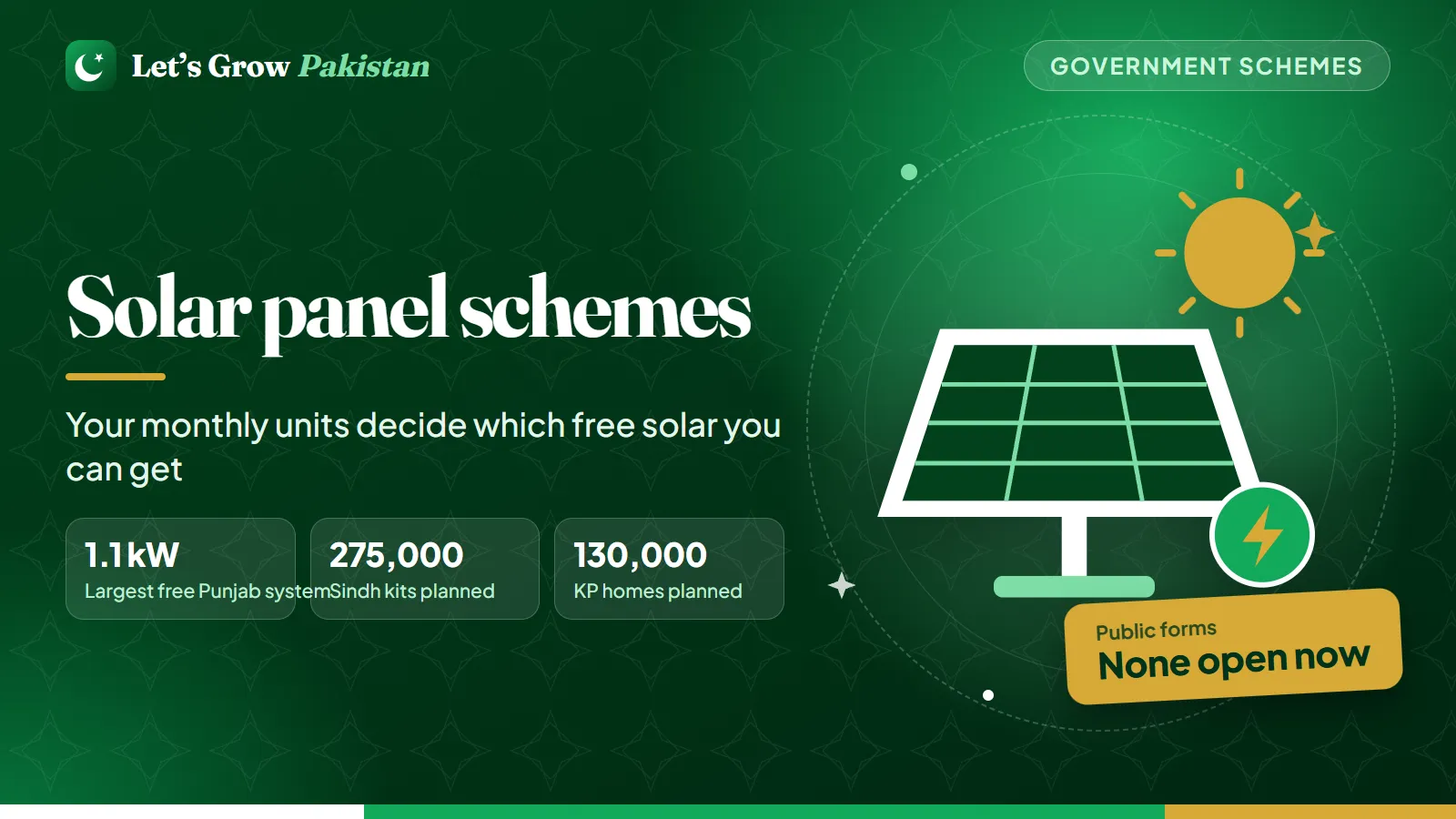
Your chances start with one figure on your electricity bill: units used last month. Every free solar scheme in Pakistan so far has picked homes by units, by poverty score or by having no grid connection at all. Today none of them has a public form open. Two are still handing over systems, and two are waiting on paperwork.
| Province | Scheme | Who it is for | Units limit | What you get | Status on 7 November 2026 |
|---|---|---|---|---|---|
| Punjab | CM Punjab Free Solar Panel Scheme | Domestic consumers with a load of 2 kW or less | Up to 200 units on the June 2024 bill | A free 0.55 kW or 1.1 kW standalone system | Registration closed. Deliveries extended to December 2026 |
| Sindh | Solar Home Systems, Phase II | Poor households, BISP poverty score 0 to 20 first | Protected consumers using 0 to 100 units, or homes with no grid | A free 180 W kit with battery, fan and 3 lights | Running. More than 15,000 installed by 17 July 2026 |
| Sindh | Solar Installment Plan for the middle class | Middle income families | None announced | Rooftop solar paid in instalments close to your current bill | Announced June 2026. No terms or form yet |
| Khyber Pakhtunkhwa | Solarisation of Houses | Vulnerable households, district quotas | None published | 65,000 free systems and 65,000 at half price | Planned. No handover confirmed |
| KP merged districts | Federally funded solar project | Homes in the merged districts | None published | A 2 kW system, as reported | Delayed. None delivered by 9 March 2026 |
| Federal | No household scheme found |
Match your monthly units to a scheme
Look at the units line and the past months printed on your bill. Then find your row.
| Units you use a month | What may apply to you | Can you act today |
|---|---|---|
| Up to 100 | Punjab 0.55 kW system. Sindh free kit if you are a protected consumer | Punjab is closed. Sindh selects from the BISP list |
| 101 to 200 | Punjab 1.1 kW system | Closed. Ballot results only |
| More than 200 | No free scheme. Sindh’s instalment plan, once it opens | Nothing to apply for yet |
| No grid connection | Sindh off grid kits. KP merged districts project | Sindh is running. KP is delayed |
Three lines on the bill decide most of this. The first is units consumed, with the history of earlier months beside it. The second is sanctioned load, in kW. The third is your tariff, which shows whether you count as a protected consumer. Under the federal rule, a home is protected when it used 200 units or less in each of the last six months. One month above 200 can drop you out. If your bill puzzles you, our bills section explains the terms.
Sindh CM review, 17 July 2026. KP CM review, 6 March 2026. Punjab ballot, March 2025
Punjab gave away two sizes of system
Punjab’s scheme is the one most people mean when they search for free solar panels. It is closed to new names. It is still delivering.
Chief Minister Maryam Nawaz opened it with an electronic ballot on 3 March 2025. About 861,000 households had applied. The draw picked 94,483 of them, according to Dawn’s report the next day. Systems were tied to the owner’s CNIC so that panels and inverters could not simply be sold on.
| Monthly units | System | Systems in the first ballot |
|---|---|---|
| Up to 100 | 0.55 kW | 47,182 |
| 101 to 200 | 1.1 kW | 47,301 |
| Total | 94,483 |
The 47,182 figure was misprinted in the original report. It is the total minus the 1.1 kW count.
The rules that decided who got in
The portal still lists the conditions. Eligibility used the June 2024 bill.
- A domestic connection using up to 200 units a month.
- A sanctioned load of up to 2 kW.
- Lifeline, protected and unprotected users in those bands could all register.
- Electricity theft, a defective meter, or several meters at one home ruled you out.
- So did more than 3 late payments in 12 months.
Registration ran on the portal and by SMS to 8800, sending the bill reference number and CNIC. Both routes are now shut.
The extension to December 2026
On 13 April 2026, APP reported that the chief minister had extended the scheme by six months. The new end date is December 2026, up from June. The plan covers more than 94,000 systems at about Rs 10 billion, chosen by lottery. Officials said more than 800,000 applications had come in.
Checking your result
If you applied, the result page is the only step left. The ballot result page asks for a reference number and a captcha. It does not ask for any payment.
- 1
Keep your bill
Use the bill you registered with. It carries the reference number.
- 2
Open the result page
Use only cmsolarscheme.punjab.gov.pk. Check the address before typing.
- 3
Enter and submit
Type the reference number and captcha, then press Submit.
- 4
Expect a visit
Selected homes are verified in person before installation.
The portal lists no phone helpline. Its only contact is support@cmsolarscheme.punjab.gov.pk.
Roshan Gharana never opened
Punjab announced the Roshan Gharana programme in July 2024. Reports at the time described solar for homes using up to 500 units. Part was to be free, and part on interest free instalments through the Bank of Punjab or National Bank. The upfront share was reported as 10% in some places and 25% in others. We found no portal, no form and no ballot for it. In 2024 the programme’s own director said no registration was under way and that sites taking applications were run by scammers. The free panel scheme above is what actually reached homes.
Sindh hands out small kits to the poorest homes
Sindh’s scheme is the only one still putting systems into new homes. It is not a rooftop system. It is a free kit sized for a fan, lights and phone charging.
What comes in the box
At the chief minister’s review on 17 July 2026, officials listed the kit as follows.
| Part | Specification |
|---|---|
| Solar panel | 180 W |
| Control unit | With a 30Ah LiFePO4 battery |
| Charge controller | Included |
| Fan | 25 W DC pedestal fan |
| Lights | Three 5 W LED lights |
| Phone charging | Included |
| Warranty | Two years of maintenance |
The kit will not run a fridge, an iron or an air cooler. It is meant to keep a fan and lights going during load shedding or where there is no grid.
Who is chosen
Phase II covers 275,000 households. Of these, 132,000 are off grid and 143,000 are on grid.
- On grid homes: protected consumers using 0 to 100 units a month.
- Off grid homes: poor households in remote, desert, Kohistan and katcha areas.
- Priority: families in the BISP database with a poverty score of 0 to 20.
There is no open form. Households are identified from the BISP database and then invited, as officials said before the April launch. If you are unsure of your BISP status, the 8171 check is the place to start.
How far it has got
Bilawal Bhutto Zardari and the chief minister were due to launch Phase II in Larkana on 15 April 2026. Handovers that day were held in Khairpur, Larkana, Qambar Shahdadkot and Shikarpur. Larkana and Qambar Shahdadkot were each allotted 10,000 kits. By 17 July, the chief minister’s progress review found more than 15,000 kits distributed and installed across the province. The project is funded at Rs 18.206 billion from the provincial development budget and runs to June 2027.
- 275,000
- Phase II households
- 15,000+
- Installed by 17 July 2026
- Rs 18.206 billion
- Phase II cost
- About Rs 66,200
- Cost per kit, our arithmetic
The National Energy and Transport Corporation supplies the kits. The Sindh Rural Support Organisation installs them and handles repairs. No public helpline has been published.
Phase I came first. The World Bank backed Sindh Solar Energy Project had installed 170,383 home systems against a target of 200,000 by late January 2026, APP reported then. Some reports mix the two phases, so check which one a figure refers to.
The middle class plan has no terms yet
In the 2026 to 27 budget speech on 17 June, Chief Minister Murad Ali Shah promised subsidised solar financing for middle income families. At a press conference the next day he called it a Solar Installment Plan. A household would pay a monthly instalment about equal to its current bill for three to four years, then keep the system.
Khyber Pakhtunkhwa promised half free, half at half price
KP’s plan is the most generous on paper. It has also been the slowest to reach homes.
Then Chief Minister Ali Amin Gandapur launched Solarisation of Houses on 8 March 2025. More than 2.538 million people applied online. An electronic ballot picked 32,500 households for free systems in the first phase. The project was costed at Rs 20 billion. Each home was to get panels, batteries, fans and lights. No system size was published.
On 6 March 2026, Chief Minister Sohail Afridi chaired a review and ordered faster work. The plan now reads like this:
| Category | Households | Price to the household |
|---|---|---|
| Category 1 | 65,000 | Free |
| Category 2 | 65,000 | Half price, on instalments |
| Total | 130,000 |
Quotas go to districts by population. Widows, people with disabilities, displaced families, disaster hit households and off grid residents get priority. At that meeting the project document (PC-1) was still waiting for the provincial development working party. We found no official report of systems reaching homes by 7 November 2026, and no instalment terms. The province’s Ehsaas Apna Ghar housing loan splits its quota by district population too.
The merged districts project
A separate project, paid for by the federal government, covers the merged districts. Bajaur, Khyber, Kurram, Orakzai, Mohmand and North and South Waziristan are named. It was approved in 2024 at about Rs 13.32 billion, with 2 kW systems in reports. By 9 March 2026, no household had received one, Profit reported. The chief minister blamed technical problems, said they were solved and promised systems by June. Household counts conflict across sources: 30,000, 120,000 and 130,000 have all been published.
Federal money, but no national scheme
We found no federal scheme that gives solar systems to households across Pakistan as of 7 November 2026. Federal funds pay for the KP merged districts project. Everything else on this page is run by a province.
On the farm side, Punjab’s tubewell solar subsidy has closed, and Balochistan’s tube well scheme moves legal connections off the grid with federal and provincial money. Both are listed in our schemes directory.
What net billing changes, and what it does not
The free Punjab and Sindh systems are standalone. They do not feed the grid, so export rules do not touch them.
They matter if you plan to buy your own rooftop system, including through Sindh’s instalment plan. NEPRA’s Prosumer Regulations 2026, in force from 9 February 2026, replaced net metering with net billing for new users. Exported units are now bought at a lower rate instead of being swapped one for one. After the prime minister ordered a review, NEPRA moved to keep existing users on their old contracts until those expire. Our net metering guide compares the old and new bills. Ask your distribution company for the current buyback rate before you size a system. In Peshawar, our PESCO bill guide shows where PESCO takes net metering applications.
Fake solar registration sites
Every one of these schemes has drawn copycat sites. Some promise a “Phase 2”, a 300 unit limit or a 0% solar loan that no official page mentions.
- Punjab’s only official address is cmsolarscheme.punjab.gov.pk, and its registration is closed.
- Sindh does not take online registrations. It selects from the BISP database.
- KP has not opened a form for the 130,000 home plan.
- No scheme charges a registration, survey or processing fee.
- Never send money by mobile wallet to be “added to the list”.
- Results come from the portal or official SMS, not from WhatsApp groups.
- 3 March 2025Punjab ballot
94,483 homes picked.
- 8 March 2025KP launch
32,500 free systems in phase one.
- January 2026Sindh Phase I
170,383 kits installed.
- 9 February 2026Net billing starts
- 6 March 2026KP review
130,000 homes planned.
- 13 April 2026Punjab extended
Runs to December 2026.
- 15 April 2026Sindh Phase II launch
- 17 June 2026Sindh instalment plan announced
- 17 July 2026Sindh passes 15,000 kits
- December 2026Punjab deadline
Where each figure comes from
| Figure | Source | Date |
|---|---|---|
| Punjab eligibility, closed status, result page | Official portal, cmsolarscheme.punjab.gov.pk | Checked 7 November 2026 |
| Punjab ballot of 94,483 and system sizes | Dawn | 4 March 2025 |
| Punjab extension to December 2026 | APP | 13 April 2026 |
| Sindh kit, eligibility, 15,000 installed, cost | APP, chief minister’s review | 17 July 2026 |
| Sindh Phase II launch and BISP selection | Dawn | 15 and 16 April 2026 |
| Sindh Phase I total | APP | January 2026 |
| Sindh instalment plan | Budget speech and press conference | 17 and 18 June 2026 |
| KP 130,000 plan and priorities | APP, chief minister’s review | 6 March 2026 |
| KP first ballot | APP | 8 March 2025 |
| KP merged districts delay | Profit | 9 March 2026 |
| Net billing rules | NEPRA Prosumer Regulations 2026 | 9 February 2026 |
Where sources disagree, we say so and follow the government figure.
Frequently asked questions
Is the CM Punjab free solar panel scheme open for registration now?
No. The official portal says registrations are closed. In April 2026 Punjab extended the delivery period to December 2026 for more than 94,000 systems, but it did not open a new form. Past applicants can only check their ballot result.
Which solar system size does Punjab give for my monthly units?
Homes that used up to 100 units a month got a 0.55 kW system, and homes using 101 to 200 units got 1.1 kW. Eligibility was judged on the June 2024 bill, with a sanctioned load of 2 kW or less.
Who gets the free solar kit in Sindh?
Protected consumers using 0 to 100 units a month, and poor households in off grid areas such as the desert, Kohistan and the katcha. Families in the BISP database with a poverty score of 0 to 20 come first.
When will Khyber Pakhtunkhwa hand over solar systems to homes?
No date is confirmed. In March 2026 the chief minister ordered a quick start for 130,000 homes, half free and half at half price. We found no official report of systems reaching homes by 7 November 2026.
Is there a federal solar panel scheme for the whole of Pakistan?
We found none for households as of 7 November 2026. Federal money pays for the solar project in KP's merged districts, but every scheme that hands systems to homes is run by a province.
How can I tell a fake solar scheme registration site?
Official Punjab pages end in punjab.gov.pk, and no scheme asks for a fee or a wallet transfer. Sindh picks homes from the BISP database, so a site offering Sindh registration for money is not official.
Last updated: