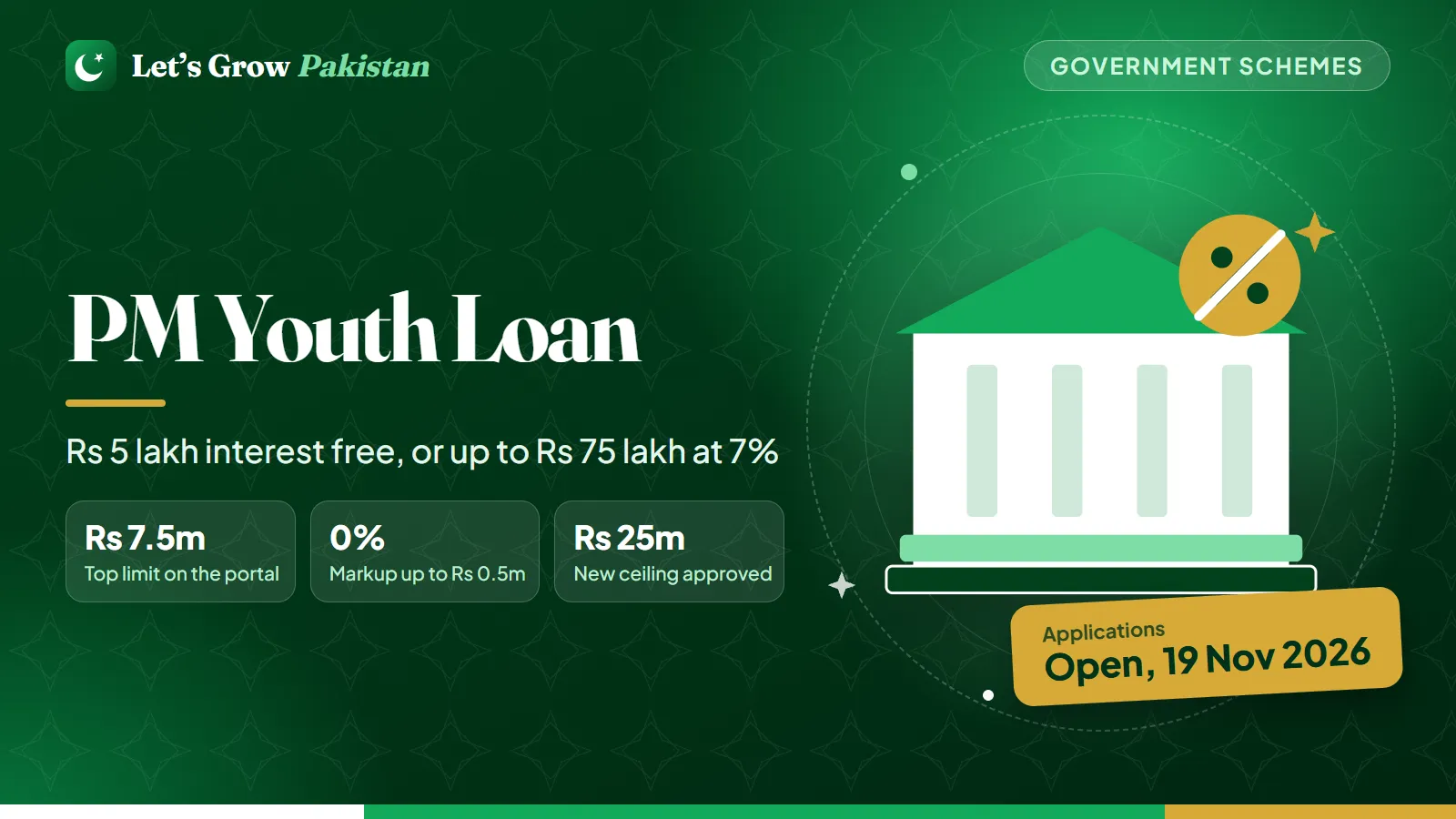
Rs 5 lakh at 0%, Rs 15 lakh at 5% and Rs 75 lakh at 7% are the 3 PM youth loans open on 19 November 2026. A fourth tier of up to Rs 2.5 crore at 8% is approved but not yet on the portal.
| Tier 1 | Tier 2 | Tier 3 | |
|---|---|---|---|
| Loan amount | Up to Rs 0.5 million, no minimum | Above Rs 0.5 million to Rs 1.5 million | Above Rs 1.5 million to Rs 7.5 million |
| Markup a year | 0% | 5% | 7% |
| Longest tenure | 3 years (crop loans 1 year) | 8 years (working capital 5 years) | 8 years (working capital 5 years) |
| Grace period | Not fixed, agreed with the lender | Up to 1 year | Up to 1 year |
| Repayment | Equal monthly instalments | As agreed with the bank | As agreed with the bank |
| Security | Personal guarantee only | Personal guarantee only | Collateral under the bank’s policy |
| Your own share, new business | 10% | 10% | 20% |
| Your own share, existing business | None | None | None |
- 0%, 5%, 7%
- Markup in the three live tiers
- Rs 7.5 million
- Most you can apply for today
- Rs 25 million
- New ceiling approved in November 2026
- Rs 292 billion
- Set aside for youth loans in 2026 to 2027
3 approvals behind the Rs 25 million tier
The Rs 25 million tier rests on 3 dated decisions: an ECC approval, a Prime Minister’s order and the chairman’s confirmation. A higher ceiling had been talked about since February 2026, when the chairman spoke of Rs 25.3 million. This month it became a government decision.
| Date | Who | What was said |
|---|---|---|
| 4 November 2026 | Economic Coordination Committee | Allowed the proposed revision of the scheme’s tiers and bank rate |
| 8 November 2026 | Prime Minister Shehbaz Sharif | Raised the personal loan limit from Rs 7.5 million to Rs 25 million; ordered 30% of loans for women and a minimum age of 18 |
| 10 November 2026 | PMYP chairman Rana Mashhood Ahmad Khan | Confirmed the Rs 25 million ceiling and promised facilitation centres across the country |
Radio Pakistan carried the Prime Minister’s decision the same day. The meeting also heard that Rs 313.9 billion had gone to young borrowers since January 2023. The portal had not added the new tier by 19 November.
Tier 4 terms announced on 10 November
Tier 4 covers loans above Rs 7.5 million up to Rs 25 million at 8% for up to 8 years, the chairman said on 10 November. The Express Tribune and ARY News reported these terms from his press conference. Banks’ margin on Tier 3 and Tier 4 falls from KIBOR plus 3% to KIBOR plus 2.4%. The government pays that margin, not the borrower.
| Tier 4 (announced) | |
|---|---|
| Loan amount | Above Rs 7.5 million to Rs 25 million |
| Markup for the borrower | 8% |
| Longest tenure | 8 years |
| Security and own share | Not published yet |
| Where to apply | Not on the portal on 19 November 2026 |
Collateral and equity rules for Tier 4 are not published yet. Tier 3 already asks for collateral and a 20% owner’s share from a new business. Banks carry most of the risk on loans this large, so Tier 3 rules are the nearest guide until a bank confirms the terms.
2 changes for women and younger borrowers
The 8 November meeting ordered 2 more changes: 30% of loans for women and a minimum age of 18 for every borrower. The women’s share rises from the earlier 25% target. Neither change appeared in the portal’s eligibility rules on 19 November. The portal still lists 21 to 45, or 18 for IT and e-commerce.
How to pick from the 3 live tiers
The loan amount sets the tier, not the type of business. A shop, a dairy farm and a software house all fall in Tier 1 when they borrow Rs 5 lakh or less. Markup stays fixed for the borrower, because the federal government pays the bank the difference.
Tier 1 for a first business up to Rs 5 lakh
Tier 1 lends up to Rs 5 lakh at 0% against a personal guarantee only. There is no minimum amount, so a borrower can ask for just Rs 1 lakh. Repayment runs as equal monthly instalments over up to 3 years. Crop loans are the exception and are repaid in one go at harvest, within a year.
Tier 2 up to Rs 15 lakh without collateral
Tier 2 lends up to Rs 15 lakh at 5% on a personal guarantee. A new business puts in 10% of the project cost itself. A business that already runs puts in nothing at all.
Tier 3 and the 3 loss sharing levels
Tier 3 asks for collateral because the government shares less of its losses. The State Bank’s FAQs set the government’s share of lost principal at up to 50% in Tier 1, 25% in Tier 2 and 10% in Tier 3. In Tier 3 the bank carries almost all the risk. It therefore asks for collateral and a 20% owner’s share from a new business.
A vehicle financed under Tier 2 or Tier 3 serves as security in its own right. Any locally made vehicle used for business qualifies, from a loader rickshaw to a car. The usual limit is one vehicle per borrower.
2 loans at once within Rs 7.5 million
Two loans can run side by side when both together stay within Rs 7.5 million. Each loan carries its own tier’s rate. The State Bank’s example pairs a Rs 1.5 million short term loan at 5% with a Rs 6 million long term loan at 7%.
What we like
- Tier 1 carries no markup and needs no collateral
- Fixed rates of 5% and 7% do not move with the policy rate
- Two loans at once are allowed: one short term, one long term
- Money can be paid in tranches or straight to your supplier
!Watch out for
- Tier 3 needs property or other collateral
- A late payment stays on your credit report for two years
- Old loans cannot be swapped into the scheme
- The bank still decides, so a weak plan is refused
PM youth loan instalment for each tier
A Rs 5 lakh Tier 1 loan costs Rs 13,889 a month over 36 months, with no markup. The other figures below are our estimates on a standard reducing balance schedule at the official rates. The portal’s own repayment calculator gives a second opinion.
Monthly instalments for 5 sample loans
| Loan | Rate | Months | Monthly instalment | Total markup paid |
|---|---|---|---|---|
| Rs 500,000 (Tier 1) | 0% | 36 | Rs 13,889 | Rs 0 |
| Rs 1,500,000 (Tier 2) | 5% | 60 | About Rs 28,307 | About Rs 198,420 |
| Rs 1,500,000 (Tier 2) | 5% | 96 | About Rs 18,990 | About Rs 323,040 |
| Rs 3,000,000 (Tier 3) | 7% | 60 | About Rs 59,404 | About Rs 564,240 |
| Rs 7,500,000 (Tier 3) | 7% | 96 | About Rs 102,253 | About Rs 2,316,288 |
A longer tenure lowers the monthly bill but raises the total cost. Rs 1.5 million costs about Rs 198,420 in markup over 5 years and about Rs 323,040 over 8 years. For most small businesses the Tier 1 instalment of under Rs 14,000 is the easiest to carry.
Grace year and the Tier 4 estimate
A one year grace period on Rs 7.5 million costs about Rs 43,750 a month in markup only. At the announced Tier 4 terms, Rs 25 million at 8% over 96 months comes to about Rs 353,400 a month. Total markup over the 8 years is about Rs 8.93 million. A grace year on that loan costs about Rs 166,700 a month in markup alone.
Age limit and 5 eligibility rules
An applicant qualifies when all 5 of these rules are met:
- Citizenship: You are a Pakistani citizen with a valid CNIC or SNIC, living in Pakistan.
- Age: You are 21 to 45 on the day you apply, or 18 with at least matric for an IT or e-commerce business.
- Business: You start a new business or expand a running one, and youth owned small and medium firms qualify too.
- Credit record: Your eCIB report shows no current overdue loan and no write off.
- Licence: Your business holds any licence the law requires, and no school certificate is asked for otherwise.
Partnerships, companies and the age cut off
Only one owner, partner or director of a partnership or company has to fall within the age range. Age counts on the application date only. A 44 year old can therefore take an 8 year loan.
5 groups shut out of the scheme
Five groups cannot borrow under the scheme, whatever their plan. The table names each one and the rule behind it.
| Person | Why | Rule from |
|---|---|---|
| Government employee | Not allowed to borrow under the scheme | State Bank FAQs |
| Non resident Pakistani | Not eligible | Official portal |
| Guarantor of another youth loan | Cannot take a loan of their own | Official portal |
| Borrower wanting to shift old bank debt | Existing loans cannot be swapped in | State Bank FAQs |
| Third application on one CNIC | Each CNIC may submit at most two | Official portal |
Women were only 11% of borrowers in February 2026, the chairman said then. On 10 November he put the total at more than 121,000 women and Rs 36.6 billion since 2023, The Express Tribune reported. The new 30% quota aims to lift that share.
Farm loans, 62.8% of the scheme
Farmers held 62.8% of all loans paid out by the end of 2025, and 52.3% of the money. The word “agriculture” in the scheme’s name matters more than most people realise. Two kinds of farm finance are allowed: crop production loans and development loans.
Crop production loans repaid at harvest
A crop production loan is repaid in one lump sum within a year, tied to the harvest. Tier 1 farm loans averaged about Rs 109,500 each. The amount per acre follows the State Bank’s indicative credit limits for agriculture.
Development loans for 3 kinds of farm assets
Development loans pay for tube wells, livestock sheds and farm machinery over up to 8 years in Tier 2 or Tier 3. Farmers in Punjab can compare this with the interest free Kisan Card, which pays for inputs through a card rather than cash. A youth loan suits a farmer under 45 who wants equipment or a dairy or poultry unit.
Applying on pmybals.pmyp.gov.pk
The PM youth loan application is online only, in 5 steps. The portal says no paper form is needed at a branch. Banks are still allowed to help applicants fill in the form.
- 1
Pick your tier
Work out the amount first. It decides your rate and the security you need.
- 2
Write a short plan
The portal has free templates for a balance sheet, cash flow, income statement and repayment plan.
- 3
Fill the online form
Choose Apply for Loan, enter your CNIC and business details, then pick a bank and branch.
- 4
Meet the bank
The bank checks your credit record, collects papers and your guarantee, and may visit the site.
- 5
Track and receive
Follow the case with your CNIC on the Track page. Approved money goes to you or your supplier.

The Prime Minister’s Youth Programme posted this short guide when the scheme relaunched in January 2023. The Tier 1 terms it covers, up to Rs 5 lakh at 0%, have not changed since. Some portal screens may look slightly different today.
Writing the business plan the bank reads
A feasibility report weighs heavily with the bank. It sets out 3 things: what you buy, what it costs, and how many months it takes to earn the instalment. SMEDA’s free pre feasibility studies give ready costings for common small businesses. When the business depends on a trade you have not learned yet, NAVTTC free courses teach it at no cost.
Free help from 4 SMEDA offices
SMEDA gives free business advice through the 4 provincial offices listed below.
| SMEDA office | Phone |
|---|---|
| Lahore (head office) | 042 111 111 456 |
| Karachi | 021 111 111 456 |
| Peshawar | 091 111 111 456 |
| Quetta | 081 2831623 |
SMEDA signed an agreement with the programme on 10 September 2026, APP reported. It covers training on eligibility and documents, business plan templates, and help desks in regional offices. The same agreement covers sharing data on refused applications.
PM youth loan documents list
Every applicant brings 7 core papers, and 6 kinds of case add more. The lists come from Allied Bank’s scheme page. Other banks ask for much the same.
7 papers every applicant needs
| Document | Note |
|---|---|
| Loan application form, English and Urdu | Generated from the online form |
| Valid CNIC or SNIC | Checked through NADRA |
| Two recent passport size photographs | Recent and clear |
| Feasibility report or business plan | The portal templates are enough |
| Two reference CNICs | From people who know you |
| Clean eCIB credit report | The bank pulls it |
| Undertaking to borrow from one bank only | Signed at the branch |
Extra papers for 6 cases
| Your case | Extra papers |
|---|---|
| Running business | Business financials, bank statements, utility bills, as the bank’s credit policy requires |
| Taxed or licensed trade | NTN, tax returns, business licence |
| Plan built on a skill | Education, technical or experience certificates |
| Vehicle loan | Driving licence |
| Partnership or company | Partnership deed or company documents |
| Tier 3 | Collateral papers and valuation |
Rs 100 fee and a 45 day target
Allied Bank lists the processing fee as Rs 100 and aims to decide a case in about 45 days. Bank Alfalah says only that timing follows the State Bank’s prudential rules. A case that drags past that point deserves a written reason from the branch.
PM youth loan status check and rejection
The portal shows the status, but the bank branch named on the form makes the decision. Most delays and refusals are sorted out at that branch. The three parts below cover tracking, refusals and complaints.
Tracking with your CNIC
To check the status, open Track on pmybals.pmyp.gov.pk and enter the CNIC used on the form. The bank also calls applicants to collect papers and arrange a site visit. A missed call from the branch can hold a case for weeks, so keep the number on the form active.
5 common PM youth loan rejected reasons
The 5 common refusal reasons are a bad eCIB record, the age limit, a government job, a weak plan and missing papers. The programme publishes no official list, so each reason below follows from a published rule.
| Reason | Rule behind it | What to do |
|---|---|---|
| Overdue loan or write off on eCIB | State Bank eligibility rule | Clear or settle the loan, then wait for the report to update |
| Age outside 21 to 45 | Portal eligibility | Wait for the age change to reach the portal, or apply under IT and e-commerce at 18 |
| Government job | State Bank FAQs | Not curable while in service |
| Weak or unrealistic plan | Bank’s own credit decision | Rebuild costings with SMEDA’s templates |
| Missing licence or papers | Bank’s credit policy | Get the licence, then reapply |
SMEDA and the programme agreed in September 2026 to share data on refused applications and their reasons. The aim is to send help where cases fail most. SMEDA help desks already explain eligibility and documents for free.
Reapplying and 3 complaint routes
A refused applicant can apply once more, because each CNIC is allowed 2 applications. Complaints about the scheme go to the Pakistan Citizen Portal app, the route the application page names. Complaints about a bank’s handling go first to that bank. When its answer falls short, the Banking Mohtasib Pakistan hears the case free of charge.
15 banks that lend under the scheme
The loans go through 15 commercial, Islamic and SME banks, the portal says, without naming them. Applicants pick one bank on the form. The 12 banks below publish their own scheme pages, which we checked in November 2026.
12 named banks by type
| Type | Banks |
|---|---|
| Large commercial banks | HBL, Allied Bank, Bank Alfalah, Askari Bank, Faysal Bank, Bank AL Habib, Soneri Bank |
| Provincial and public banks | Bank of Punjab, Sindh Bank, First Women Bank |
| Islamic bank | Al Baraka Bank |
| Agriculture bank | Zarai Taraqiati Bank (ZTBL) |
Choosing a branch and the microfinance route
Pick the bank with a branch near your business, because its staff visit the site. A bank that already holds your account checks your record faster. Tier 1 loans also reach borrowers through microfinance banks and institutions, which get funds from larger wholesale lenders.
Rs 220.9 billion lent by December 2025
The State Bank counted 461,795 loans worth Rs 220.9 billion from January 2023 to 31 December 2025. It publishes these figures every quarter. The 31 December 2025 table is the latest one we could open.
Split by the 3 tiers
| Tier | Loans paid out | Amount | Average loan |
|---|---|---|---|
| Tier 1 | 395,504 | Rs 52.3 billion | About Rs 132,000 |
| Tier 2 | 15,545 | Rs 20.6 billion | About Rs 1.33 million |
| Tier 3 | 50,746 | Rs 148.0 billion | About Rs 2.92 million |
| Total | 461,795 | Rs 220.9 billion | About Rs 478,000 |
State Bank of Pakistan PMYB&ALS quarterly data, 31 December 2025
Tier 1 made 85.6% of all loans, yet Tier 3 took 67% of the money. Average loans ranged from about Rs 132,000 in Tier 1 to about Rs 2.92 million in Tier 3. That gap explains why a bigger Tier 4 matters to growing firms.
Business against farm loans
Farm loans outnumbered business loans by 289,834 to 171,961. Farm loans totalled Rs 115.5 billion and business loans Rs 105.4 billion. Farmers therefore took more loans, but smaller ones.
Repayment record and this year’s Rs 292 billion
Bad loans stood at 3,469 cases worth Rs 1.56 billion, just 0.7% of the money lent. That equals 1.07% of the amount still outstanding. Another 16,772 approved loans were still waiting for payment. The State Bank’s quarterly data page lists newer quarters as they appear.
The chairman spoke of Rs 265 billion for the year on 1 July 2026. The figure at the Prime Minister’s meeting on 8 November was Rs 292 billion. By then Rs 313.9 billion had been lent since January 2023.
Laptops, jobs abroad and 4 regional options
The scheme added 2 smaller products in February 2025, each with its own button on the portal. The State Bank’s circular of 3 February 2025 called them Tier 4. Older bank pages still use that name for laptop loans, which have nothing to do with the new Rs 25 million tier.
Laptop For All at 3 loan sizes
Laptop For All lends Rs 150,000, Rs 300,000 or Rs 450,000 for a basic, mid range or advanced laptop. Repayment runs over 4 years, and a family member stands guarantee. It serves students at HEC recognised institutions, freelancers and young entrepreneurs aged 18 to 30. It is separate from the free laptop scheme for university students.
Up to Rs 1 million for overseas workers
Prospective overseas workers aged 21 to 45 can borrow up to Rs 1 million with no markup. The money covers training, visa and travel costs. A valid job offer, or recruitment through a licensed Overseas Employment Promoter, is required. Reports in February 2025 gave a 5 year tenure while APP in April 2025 said 7 to 8 years, so the bank’s term sheet decides.
4 provincial and regional alternatives
Four nearby options are the Asaan Karobar Card, the e-bike scheme, the AJK youth loan and the GB youth loan. The interest free Asaan Karobar Card is the closest Punjab option for a small revolving facility. Young applicants who mainly need a ride to work or college may prefer the e-bike scheme.
Applicants in Azad Kashmir and Gilgit-Baltistan use this scheme on the same terms. The AJK youth loan lends Rs 1 lakh to Rs 20 lakh at 0% through the Bank of AJK. In Gilgit-Baltistan, the GB youth loan options include E-Rozgar soft loans of up to Rs 30 lakh at 5% for IT businesses. The federal Rozgar scheme named in the June 2026 budget has no terms yet, and other loans sit in the schemes directory.
Record of 8 checks
| What | Source | Checked |
|---|---|---|
| Live tiers, eligibility, Track and Citizen Portal route | Official PMYP loan portal | 19 November 2026 |
| Tenure, security, documents, fee | HBL, Allied Bank and Bank Alfalah scheme pages | 7 November 2026 |
| Grace period, two loans, age, loss sharing | State Bank scheme FAQs, 26 January 2023 | 7 November 2026 |
| Lending by tier | State Bank quarterly data to 31 December 2025 | 7 November 2026 |
| Revised tiers approved | ECC decision reported by Radio Pakistan, 4 November 2026 | 19 November 2026 |
| Rs 25 million ceiling, 30% for women, age 18 | Prime Minister’s meeting, Radio Pakistan, 8 November 2026 | 19 November 2026 |
| Tier 4 at 8% over 8 years, bank margin | Chairman’s press conference, reported 10 and 11 November 2026 | 19 November 2026 |
| SMEDA agreement | APP, 10 September 2026 | 19 November 2026 |
Instalment figures, including the Tier 4 estimate, are our own arithmetic at the official or announced rates. Each date in the table is the day we read that source. This page changes when the portal adds Tier 4.
Frequently asked questions
Is the PM youth loan open for applications in November 2026?
Yes. The official portal pmybals.pmyp.gov.pk was taking online applications on 19 November 2026, with no closing date shown. The Prime Minister said on 8 November that Rs 292 billion has been set aside for youth loans this financial year.
Has the PM youth loan limit been raised to Rs 25 million?
The government has approved it. The ECC cleared revised tiers on 4 November and the Prime Minister announced Rs 25 million on 8 November. On 19 November the portal still offered three tiers up to Rs 7.5 million, so ask your bank before applying above that.
Do I need collateral for a loan of Rs 5 lakh or Rs 15 lakh?
No. Tier 1 (up to Rs 0.5 million) and Tier 2 (up to Rs 1.5 million) are clean loans backed by your personal guarantee. Only Tier 3 needs collateral under the bank's own credit policy, and a financed vehicle can count.
How do I check my PM youth loan status?
Open the Track option on pmybals.pmyp.gov.pk and enter the CNIC you applied with. The bank you chose on the form also calls applicants during its checks, so keep that mobile number switched on and answer unknown calls from the branch.
Why was my PM youth loan application rejected?
The usual causes are an overdue or written off loan on your eCIB report, an age outside the limit, a government job, or a weak business plan. Ask the branch for the reason in writing, fix it, and use your second allowed application.
What does it cost to apply, and how long does approval take?
Allied Bank lists a processing fee of Rs 100 and says it aims to process a case in 45 days. Other banks follow State Bank prudential rules, so timing varies. Nobody is allowed to charge you for approval or for a quicker decision.
Can government employees or Pakistanis living abroad apply?
No. The State Bank's FAQs say government employees cannot borrow under the scheme, and the official portal says non resident Pakistanis are not eligible. A person who is a guarantor on another youth loan also cannot apply for one.
Last updated: