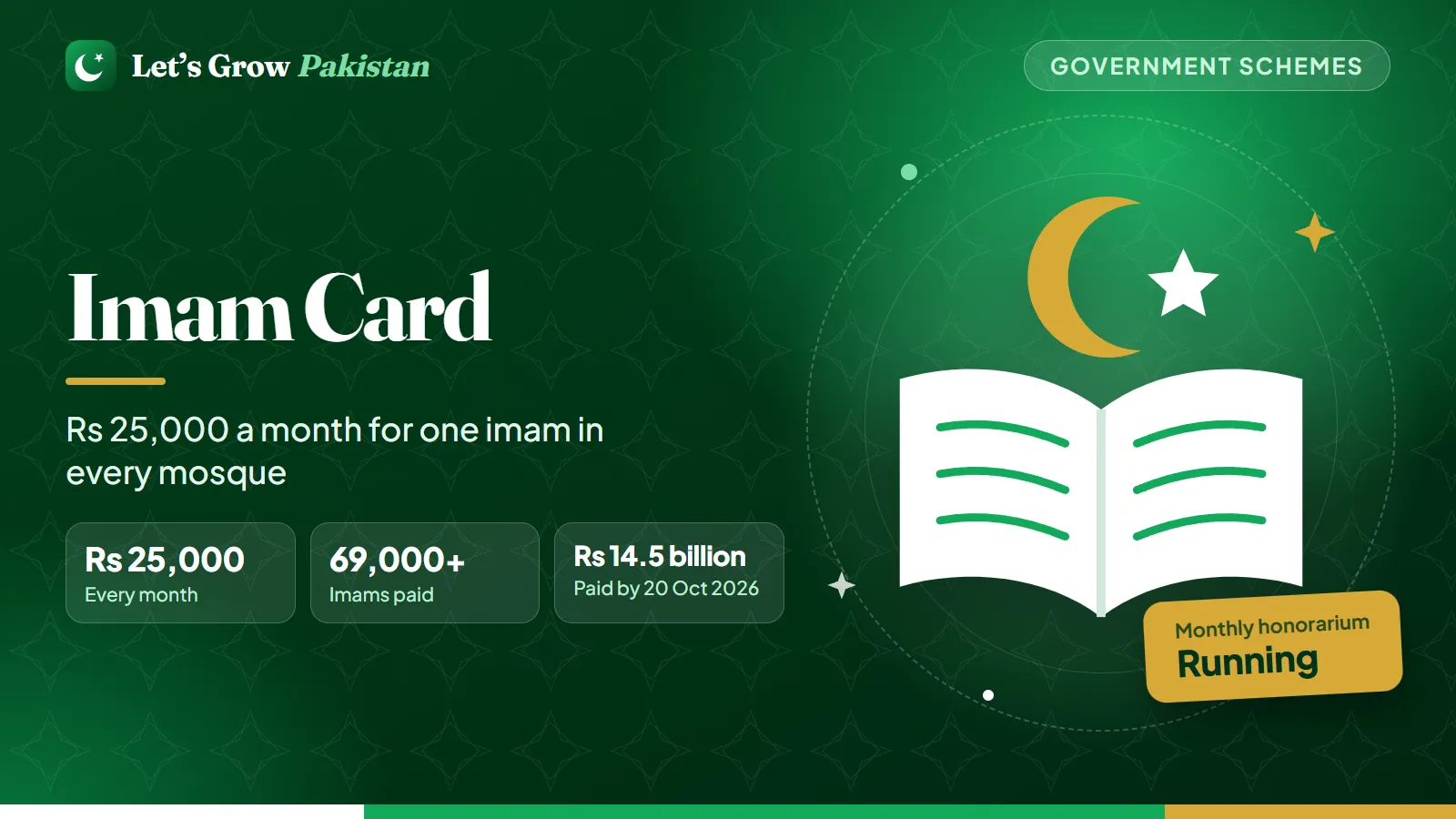
Rs 25,000 lands in a Bank of Punjab account each month for more than 69,000 mosque imams in Punjab. To join them, an imam needs one signed form, a clean security check and a mosque that no other imam is already claiming.
- Rs 25,000
- Paid every month
- Rs 300,000
- A year, 12 payments
- 69,000+
- Imams receiving it, August 2026
- 76,000+
- Mosques registered, October 2026
Imam card payment and schedule
The honorarium is a flat Rs 25,000 a month. The policy adds “or any higher amount the government approves”, so the figure can rise without a new scheme. Nothing higher has been approved so far.
How the first payments were made
The programme started on 1 January 2026. That first month was paid by pay order, collected from the office of the assistant commissioner. From February 2026 the money moved to the honorarium card, and after that the card became the only way to draw it.
| Item | What the rules and officials say |
|---|---|
| Amount | Rs 25,000 a month, or any higher amount the government approves |
| Yearly total | Rs 300,000 (our arithmetic, 12 months) |
| Start date | 1 January 2026 |
| January 2026 payment | Pay order, collected at the assistant commissioner’s office |
| From February 2026 | Bank of Punjab honorarium card only |
| Card name | Chief Minister Punjab Honorarium Card for Imam Masjid |
| Fixed pay day | Not published. Officials describe payments only as monthly |
| Bank rule | At least one transaction every three months keeps the account active |
| Proof of life | Biometric check by Bank of Punjab twice a year |
The three month transaction rule
At the steering committee meeting of 20 October 2026, imams were told to make at least one transaction every three months. The rule exists to keep accounts active and avoid breaks in payment. The officials did not list which transactions qualify, so a cash withdrawal is the safest choice.
Biometric proof of life
Bank of Punjab checks every beneficiary’s fingerprints twice a year. The government pays for these checks. The bank has not published fixed dates for the rounds, so watch for word from the bank or the tehsil office.
Who qualifies for the imam card
The Home Department’s notified policy is short and strict. It is built around one person per mosque and a clean record.
The conditions an imam must meet
| Condition | What it means |
|---|---|
| Serving imam | You lead all five daily congregational prayers at the mosque |
| Registered mosque | The mosque is registered with the Home Department through the assistant commissioner |
| Form 2 | A duly signed Home Department mosque Form 2 is on file |
| One per mosque | Only one imam of each mosque can be paid |
| Clean record | Not proscribed, not on the Fourth Schedule, not under trial for terrorism, not challaned or convicted for a scheduled heinous or moral offence |
| Security clearance | Cleared by the Special Branch and the Counter Terrorism Department |
Mosques of every sect
Punjab has over 80,000 mosques of all sects, according to the Chief Minister’s January 2026 launch. The policy does not limit the honorarium to any school of thought. Registration was the only test named at the launch.
Muezzins, khateebs and Auqaf mosques
The policy names the imam only. Muezzins, khateebs and khadims are not part of it. The scheme is run by the Home Department, not the Auqaf department, and its rules do not mention Auqaf staff. If you already draw a salary from a government mosque post, ask the assistant commissioner before applying.
Scheduled offences that disqualify
The policy groups scheduled offences into four kinds. They are crimes against the state and national security, property offences involving dishonesty, violent crimes causing bodily harm, and offences of moral turpitude, especially against women and children. A steering committee was to fix the exact legal sections.
Imam card registration step by step
There is no SMS code and no public online form for the Imam Card. Every application goes through the assistant commissioner’s office in your tehsil.
- 1
Fill in Form 2
Complete the Home Department's mosque Form 2 and get it duly signed.
- 2
Submit at the AC office
The assistant commissioner's office digitises your form on the Home Department portal.
- 3
Security vetting
Special Branch and CTD check the data. An objection means a second check.
- 4
Bank account and card
Cleared imams get a Bank of Punjab account and the honorarium card.
- 5
Monthly payment
Rs 25,000 arrives each month. Draw it at a Bank of Punjab ATM.
Documents for imam card registration
The published policy names one document: the signed Form 2. The assistant commissioner’s office keeps the form and decides what copies go with it. Bank of Punjab will need your CNIC for the account and fingerprints, so make sure it has not expired before you apply.
Phase II for districts left out
Registration began in some districts first. On 27 January 2026 Punjab started Phase II for the remaining divisions, districts and tehsils, including all six districts of Rawalpindi Division. If your area was missed earlier, Phase II is the route. It runs through the same assistant commissioner offices.
Registration has no last date
The Chief Minister ordered in December 2025 that registration should continue without a break. In October 2026 the Home Department said geotagging of mosques was moving fast and registration was still going on. No deadline has been announced, so beware of anyone who says the “last date” is tomorrow.
Imam card status check and complaints
No public page lets you type a CNIC and see your Imam Card status. Updates come through the assistant commissioner’s office and the bank.
Where to ask about your case
| Your situation | Where to go |
|---|---|
| Form submitted, no news | The assistant commissioner’s office that took your form |
| Refused after vetting | A representation to the deputy commissioner |
| Card issued, payment stopped | The assistant commissioner’s office, which can raise it on the Home Department’s online complaint portal |
| Card blocked or PIN problem | Bank of Punjab contact centre, 111 267 200, or a branch |
| Fingerprints do not match | Bank of Punjab branch, then the AC office if the check keeps failing |
On 20 October 2026 the Home Secretary said complaints on the online portal were being cleared quickly. The minister also told Bank of Punjab and PITB to fix pending online application issues. A chatbot for imams was announced at the same meeting. It has not launched yet, and no number or link was given.
What a refusal after vetting means
Each application goes electronically to the Special Branch and CTD. If either objects, the case is checked again. An imam who is still not recommended can send a representation to the deputy commissioner. The District Intelligence Committee then sends a reasoned recommendation to the Home Department. The Provincial Intelligence Committee takes the final decision.
- Step 1Data shared
Digitised details go to the Special Branch and CTD.
- Step 2Second check
An objection from either agency triggers a second check.
- Step 3Representation
A refused imam writes to the deputy commissioner.
- Step 4District Intelligence Committee
It sends a reasoned recommendation to the Home Department.
- Step 5Final decision
The Home Department decides through the Provincial Intelligence Committee.
Bank of Punjab card and cash withdrawal
The honorarium card is a Bank of Punjab debit card. Bank of Punjab accounts for registered imams had already been opened by the January 2026 launch.
By August 2026 the Home Department reported 69,000 imams paid through these cards, with Rs 21 billion allocated and Rs 9 billion paid. The payment figure has since grown to Rs 14.5 billion.
Using the card at an ATM
Bank of Punjab has not published separate activation steps for this card. Its round the clock contact centre, 111 267 200, handles debit card activation, ATM PIN generation and lost card blocking. Call it from the mobile number registered with your account, then withdraw at a Bank of Punjab ATM. Never let a helper at the ATM hold your card or watch you enter the PIN.
A blocked card or expired CNIC
If the card is blocked or lost, call 111 267 200 or visit a Bank of Punjab branch with your CNIC. Keep the CNIC valid, because the twice yearly biometric checks run on it. If it has expired, renew it at NADRA first.
How the honorarium can be stopped
The Imam Card is not a pension. It ends on the day the imam stops being the imam.
Leaving the mosque, removal or death
Eligibility ends at once if the imam leaves office, is removed by a lawful mosque management committee or competent authority, or dies. The honorarium is not heritable, so it does not pass to a son or widow. A new imam of the same mosque would need to register afresh.
Hate speech and anti state rhetoric
An allegation of hate speech or anti state rhetoric leads to a hearing at the deputy commissioner’s office. District police, Special Branch, CTD and Auqaf send representatives. If the charge is disproved, payments continue. If it is proved, the District Intelligence Committee recommends stopping the money, and the Home Department tells Bank of Punjab to stop it immediately.
Audits and recovery
A third party checks beneficiaries, payments and compliance every year. Money paid by mistake or without right is recovered by the district collector as arrears of land revenue. That is the same power used to collect unpaid land tax, so a wrongful claim can follow the imam for years.
Where the money has gone so far
The province set aside about Rs 20 billion to Rs 21 billion a year. Payments have tracked that pace closely.
Radio Pakistan, 4 August 2026; Home Department steering committee, 20 October 2026; full year figure is our arithmetic.
What the totals tell an imam
Our arithmetic shows the pace. At 69,000 imams and Rs 25,000 each, one month costs about Rs 1.73 billion. Rs 14.5 billion therefore covers about eight and a half months of full payroll. From January to September is nine months. The small gap fits imams from Phase II joining after January, rather than missed payments for everyone. An imam who joined in Phase II should count payments from his own first month, not from January. The tracker above does that.
Radio Pakistan reported on 4 August 2026 that the Rs 9 billion figure came with a second point. The paperwork for 2026 to 2027 was complete, and that year’s money had already been sent to Bank of Punjab.
From announcement to monthly payments
The scheme moved from a promise to a payroll in about two months.
- Late October 2025Promise made
The Chief Minister agreed to pay mosque imams Rs 25,000 a month.
- Early December 2025Card approved
The honorarium card was approved, with 62,994 forms already in.
- 26 December 2025Bank agreement
The Home Department signed with Bank of Punjab. Cost was put at over Rs 20 billion a year.
- 1 January 2026First payment
January was paid by pay order through assistant commissioners.
- 8 January 2026Cards launched
The Chief Minister handed out the first cards in Lahore.
- 27 January 2026Phase II
Registration opened in districts missed in Phase I.
- February 2026Card payments
Payments moved fully to the honorarium card.
- 20 October 2026Rs 14.5 billion paid
Over 76,000 mosques registered and a chatbot announced.
Why security vetting is built in
The honorarium was announced in the same week that sealed mosques were handed over after the ban on the TLP. Of the first forms, 66,000 imams were cleared after initial security and intelligence checks, as the Home Department said in January 2026. The vetting, appeal and suspension rules came with the money from day one.
Imam stipends in other provinces
Few provinces pay mosque imams directly. The one other provincial scheme we could confirm is in Khyber Pakhtunkhwa.
| Programme | Amount | Coverage | Status |
|---|---|---|---|
| Punjab Imam Card | Rs 25,000 a month | 69,000+ imams, one per mosque | Running since January 2026 |
| Khyber Pakhtunkhwa imam honorarium | Rs 10,000 a month | About 22,000 imams | Announced in January 2021; current payments not confirmed |
Khyber Pakhtunkhwa announced its Rs 10,000 honorarium in January 2021, for about 22,000 imams. We could not confirm whether those payments still run in 2026, so treat that row as history, not a live offer.
Other Punjab cards for an imam’s family
The Imam Card covers only the imam. His family may qualify separately. A household on a low income can check the ration card and the federal BISP 8171 programme. A family member with a disability may get the Himmat Card, which is also paid through Bank of Punjab. Health bills are covered by the Sehat Card.
Fake agents and paid registration
Calls claiming to be from the Home Department or the bank sometimes ask imams to “verify” a card by reading out a code. The bank says its staff never call to ask for such details. If in doubt, hang up and go to the branch or the AC office yourself.
Where these facts come from
The amount, start date and pay order rules come from the Punjab government’s honorarium page and the Home Department meetings of December 2025. Eligibility, vetting, removal and recovery rules come from the notified policy as reported on 29 January 2026. Payment totals come from the Home Department’s statements of 4 August and 20 October 2026. Phase II details are from the Punjab Religious Affairs announcement of 27 January 2026. All were checked on 13 November 2026. Every other provincial programme sits in the schemes directory, and we will update this page when the amount, the rules or a new phase changes.
Frequently asked questions
How much is the Imam Card payment in Punjab?
The Imam Card pays Rs 25,000 a month to each registered mosque imam, which comes to Rs 300,000 a year. The money goes into a Bank of Punjab account and is drawn with the honorarium card.
How do I register for the Imam Card?
Fill in the Home Department's Form 2, get it signed, and submit it at your assistant commissioner's office. The office enters it on the Home Department portal, and security vetting follows before the bank account opens.
How can I check my Imam Card status by CNIC?
No public CNIC status page has been published for this card. Ask the assistant commissioner's office that took your form, or use the Home Department's online complaint portal through that office if your payment has stopped.
Is there a last date for Imam Card registration?
No last date has been announced. The Chief Minister ordered in December 2025 that registration should continue without a break, and the Home Department reported mosque registration still going on in October 2026.
Can a muezzin or khateeb get the Imam Card?
The notified policy names only the serving imam who leads all five daily prayers, and only one imam per mosque. Muezzins, khateebs and khadims are not covered unless the government changes the policy.
Last updated: