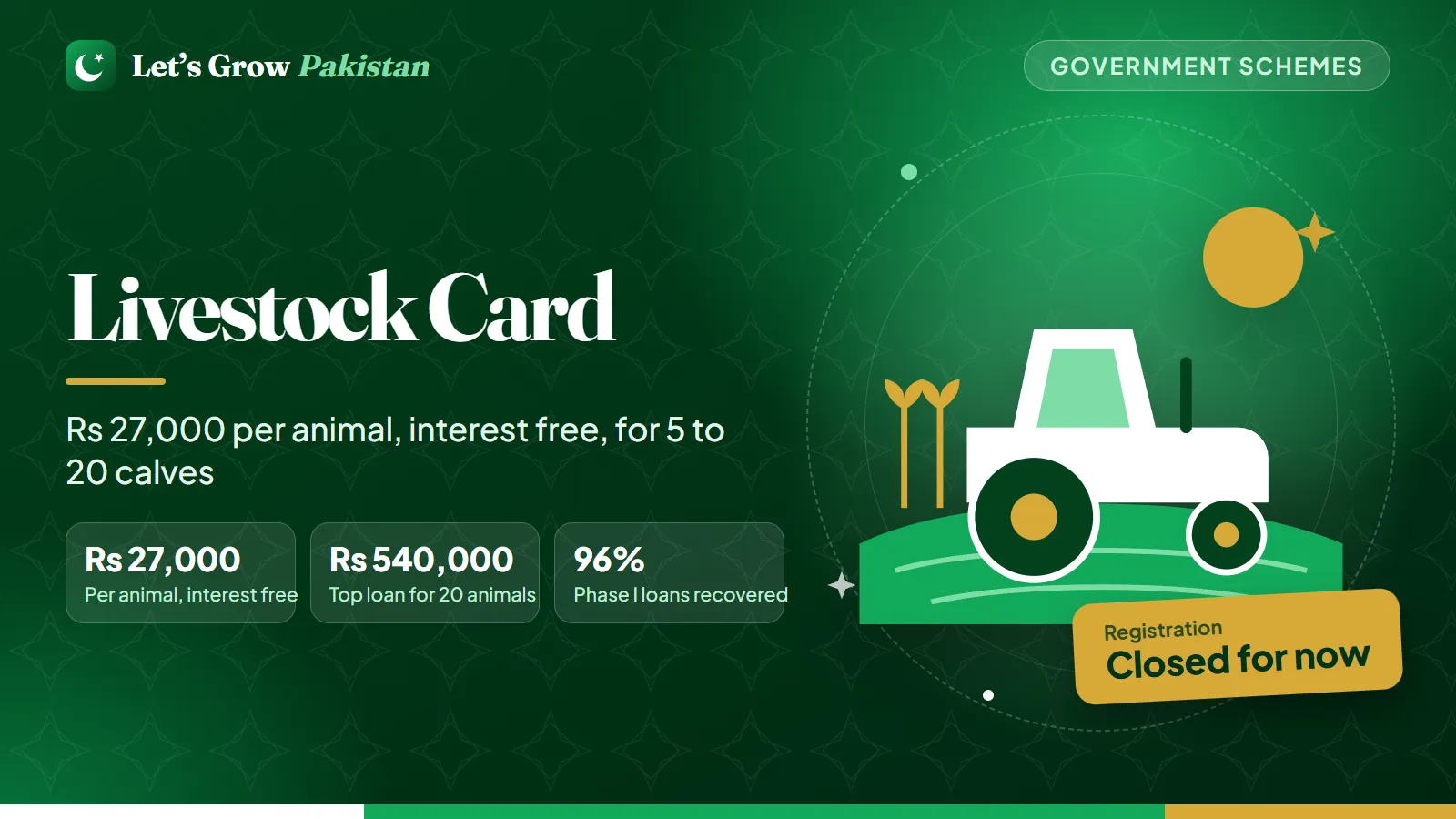
Registration for the Livestock Card is closed on 14 November 2026. Here is what the next window will offer, based on the July 2026 round.
Livestock card loan amount per animal
Each verified animal brings Rs 27,000 of interest free credit. The herd you declare sets the size of your loan, from 5 to 20 animals.
Loan for 5, 10, 15 and 20 animals
| Animals | Loan | Cash at ATM (25%) | For feed from dealers (75%) |
|---|---|---|---|
| 5 | Rs 135,000 | Rs 33,750 | Rs 101,250 |
| 10 | Rs 270,000 | Rs 67,500 | Rs 202,500 |
| 15 | Rs 405,000 | Rs 101,250 | Rs 303,750 |
| 20 | Rs 540,000 | Rs 135,000 | Rs 405,000 |
The per animal rate and the 25 percent cash share come from the 2026 announcements. The cash and feed columns are our arithmetic. A farmer with more than 20 animals is still capped at the 20 animal loan.
25 percent cash at the ATM
The cash share has changed between rounds. The 2025 round allowed up to 30 percent in cash. The July 2026 round and the October 2026 launch both put it at 25 percent. Officials said the cash is for running costs, vaccination and care.
What the rest of the loan can buy
The remaining 75 percent works only at registered dealers in your tehsil. It covers wanda, silage and mineral mixture. Your identity and card are checked at the dealer before each purchase.
Livestock card registration last date and current status
The Punjab Livestock portal at plc.punjab.gov.pk says applications for the current season are closed. It asks farmers to check back for the next season. No new date has been announced.
The July 2026 round
Applications opened on 15 July 2026. The Livestock and Dairy Development Department took them online, through a QR code, at facilitation desks in veterinary hospitals and through its helpline. On 29 July officials in Rawalpindi said about 15 to 20 days were left, with a possible extension.
Is the 8070 SMS still used
The first two rounds ran by SMS. Farmers typed PLC, a space and their CNIC, and sent it to 8070. The 2026 announcements name the portal, the desks and the helpline instead. Do not rely on 8070 for the next round until the department confirms it.
Livestock card eligibility
The conditions have stayed close across rounds. The herd size is the part that changed most.
| Condition | 2024 round | 2026 round |
|---|---|---|
| Punjab resident with valid CNIC | Yes | Yes |
| SIM in your own name | Yes | Yes |
| Animals | 5 to 10 male calves | 5 to 20 male calves |
| Clean credit record | Yes, no earlier default | Checked through the credit bureau in 2025 |
| Department registration | 9211 system | Animals verified by the department |
| Selection | First come, first served | First come, first served |
Herd size from 5 to 20 male calves
You need at least five male calves or young bulls of cattle or buffalo. The upper limit rose from 10 in 2024 to 20 in 2025 and 2026. A Multan report in July 2026 also mentioned goats and lambs, but other official statements name only calves and bulls.
SIM, CNIC and credit record
Your CNIC is checked with NADRA. The SIM must be active and registered on your own CNIC, male or female. Earlier rounds also checked the credit bureau for defaults. A farmer who still owes a government loan is likely to be refused.
Earlier cardholders must apply again
In 2025 the department said farmers who had repaid Phase I still had to apply afresh. They were promised priority. Expect the same rule in the next window, but confirm it on the helpline.
How to apply for the livestock card
- 1
Check the conditions
Punjab residence, valid CNIC, SIM in your name, 5 to 20 male calves.
- 2
Apply in the window
Use plc.punjab.gov.pk, a veterinary hospital desk or the 08000 9211 helpline.
- 3
Verification
NADRA, credit and Urban Unit checks on you and your animals.
- 4
Card issued
Rs 27,000 for each verified animal is loaded as credit.
- 5
Buy feed and repay
Up to 25 percent in cash, the rest at registered dealers.
Facilitation desks at veterinary hospitals
Farmers without a smartphone can apply in person. In July 2026, desks opened at civil veterinary hospitals in every tehsil of Rawalpindi, including Gujar Khan, Kahuta, Kallar Syedan and Taxila. Veterinary officers and assistants filled in the forms.
Documents to keep ready
Keep your original CNIC and the phone with your registered SIM. Know the number and type of male calves you keep, because officials will come to count them. No fee is charged for applying.
Livestock card status check and verification
There is no public page to check Livestock Card status by CNIC. After applying, the department verifies each case for about a month, officials said in July 2026. Cards are issued after that.
Urban Unit and NADRA checks
The Urban Unit verifies both the farmer and the animals. NADRA confirms the CNIC. Earlier rounds also screened names through NACTA. A case can fail if the animals counted do not match the application.
Helpline 08000 9211
The Livestock Department’s toll free helpline is 08000 9211, also printed as 0800 09211. It runs round the clock for guidance and complaints. Call from the SIM you applied with, so your record can be found.
Repayment and the card after approval
The farmer repays only the principal. The Punjab government pays the interest cost, as Radio Pakistan reported at the Phase II launch on 14 October 2026.
Repayment period by round
| Round | Loan use | Repayment |
|---|---|---|
| 2024 | 4 months | Then a 1 month grace period |
| 2025 | 6 months | Due in the 7th month |
| 2026 | Not published | Not published |
The 2024 terms are on the government’s Phase I page. The 2026 repayment period has not been announced, so ask the helpline before you sign.
Bank of Punjab and the card
Bank of Punjab signed the card agreement with the province in November 2024 and issued the first cards. The 2026 statements do not name the bank. They say funds go directly into approved accounts.
Why repaying on time matters
A clean repayment record is part of the eligibility check. Officials cite a 96 percent recovery rate from Phase I. A default can keep you out of later rounds and other government loans.
Phase II launch on 14 October 2026
Chief Minister Maryam Nawaz launched Phase II in Lahore by swiping a card. The government set aside Rs 16.2 billion in interest free loans.
Rs 16.2 billion for 600,000 animals
The target is better feeding for 600,000 animals over two years, to raise meat output. At Rs 27,000 per animal, that matches the Rs 16.2 billion total. That check is our arithmetic.
Free tagging and foot and mouth vaccine
Phase II adds free animal tagging. It also adds free vaccination against foot and mouth disease. Tagged animals are easier to verify, which speeds up checks on the herd you declare.
Phase names do not match
The October event was billed as Phase II. The department’s own website lists separate Phase 2 and Phase 3 pages, and APP called the July 2026 round the third phase. The rates are the same whatever the label.
How Phase I money was spent
Phase I cards were used mostly for wanda. The October 2026 launch gave these figures.
Punjab government figures at the Phase II launch, 14 October 2026.
96 percent recovery and 23,312 cards
The government said 23,312 cards were prepared under Phase I. Of those, 1,739 farmers made over 70,000 transactions. Loan recovery stood at 96 percent. A February 2026 progress report put cards distributed at 26,507, or 98 percent of target.
More women farmers
Women registered as livestock farmers rose from 90 to 1,107, the government said in October 2026. Women apply on the same terms. The SIM and CNIC must be in their own name.
Livestock Card rounds so far
- 5 Nov to 11 Dec 2024Phase I
SMS to 8070, 5 to 10 calves, Rs 135,000 to Rs 270,000.
- 27 May 2025Second round opens
SMS to 8070, 5 to 20 animals, 30 percent cash.
- 15 Nov 2025Registration closes
Last day of the 2025 round in Multan.
- 15 Jul 20262026 round opens
Online portal and desks, 25 percent cash.
- 14 Oct 2026Phase II launch
Rs 16.2 billion, Rs 27,000 per animal.
- Not announcedNext window
Portal shows the season closed.
Livestock Card and Kisan Card compared
| Item | Livestock Card | Kisan Card |
|---|---|---|
| For | Farmers with 5 to 20 male calves | Farmers who own 1 to 25 acres |
| Credit | Rs 27,000 per animal | Set per acre each season |
| Interest | None for the farmer | None for the farmer |
| Buys | Wanda, silage, mineral mix | Seed, fertiliser, pesticide |
Many farmers keep both crops and animals. The Kisan Card covers the crop side and still registers by SMS to 8070. Bigger machinery comes under the green tractor scheme.
Fake agents and paid forms
Applying for the Livestock Card is free. Officials never ask for a fee, a card PIN or a one time code by phone. Report anyone charging to “add your name” on the 08000 9211 helpline.
Rules on this page come from the Livestock and Dairy Development Department, the Phase I government page and APP reports of 14, 16 and 29 July 2026. Phase II figures are from the government’s 14 October 2026 launch. All were checked on 14 November 2026. Other farm and family programmes are in the schemes directory.
Frequently asked questions
How much loan does the Livestock Card give per animal?
The Livestock Card gives Rs 27,000 per animal, with no interest charged to the farmer. A farmer with 5 animals gets Rs 135,000, and one with 20 animals gets the maximum of Rs 540,000.
How can I apply for the Livestock Card online?
The July 2026 round took applications at plc.punjab.gov.pk, at veterinary hospital desks and through the 08000 9211 helpline. On 14 November 2026 the portal showed the season as closed, so wait for the next window.
What is the last date for Livestock Card registration?
No new last date has been announced. Registration for the latest round opened on 15 July 2026, and the portal now says the season is closed. Earlier rounds closed on 11 December 2024 and 15 November 2025.
How can I check my Livestock Card status?
No public CNIC status page has been published. Selected farmers are contacted after Urban Unit, NADRA and credit checks. For your case, call the toll free helpline 08000 9211 or ask your nearest veterinary hospital.
Can I take cash from the Livestock Card?
Yes, but only part of it. The 2026 terms let a farmer withdraw 25 percent of the loan in cash at an ATM. The rest buys wanda, silage and mineral mix from registered dealers in the tehsil.
Last updated: